
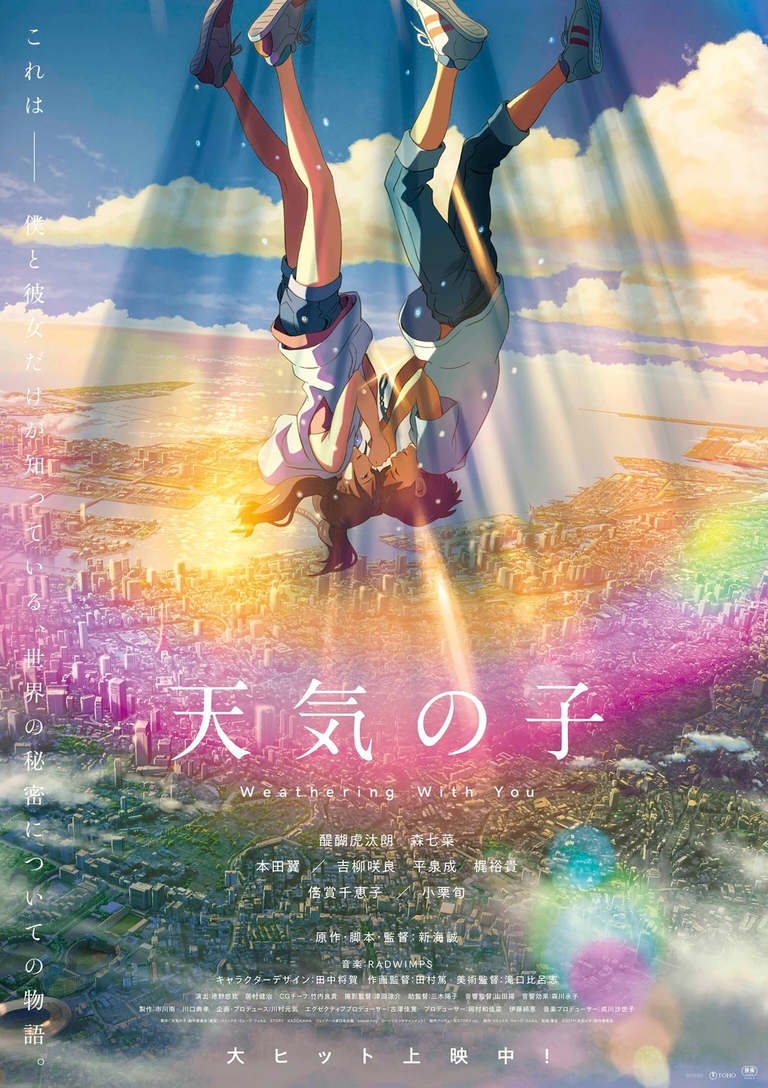
Weathering With You plot summary and ending explained discussions usually miss the point. Everyone gets caught up arguing whether Hodaka is a selfish brat who doomed millions or a romantic hero who saved one girl. That debate is surface level. The real issue is that Makoto Shinkai constructed a scenario where there is no clean answer, and he did it on purpose to make you uncomfortable with how we treat kids who fall through the cracks.
Hodaka starts as a runaway from Kozushima, some tiny island where he felt suffocated. He hops a ferry to Tokyo during the worst rainstorm in history. This isn't normal rain. It's biblical. Tokyo hasn't seen the sun in months. During the crossing he nearly dies, saved by Keisuke Suga, who hands him a business card for an occult magazine. That card becomes Hodaka's lifeline later, but first he spends weeks starving, sleeping in bathroom stalls, and finding a gun in a trash heap. Yeah, a real handgun. He keeps it like a security blanket because Tokyo is eating him alive.
He meets Hina working at McDonald's. She's fourteen, pretending to be older so she can work illegally to feed her little brother Nagi. Their mom is dead. Social services doesn't know they exist. When Hodaka sees yakuza types trying to drag Hina into a sketchy club, he pulls that gun and fires. It misses, but it buys their escape. This is the reality Shinkai shows you. These aren't magical kids having adventures. They're desperate children armed and running from the law because the adults around them are either useless or predatory.
How the Sunshine Girl Powers Actually Work
Hina takes Hodaka to this abandoned building called Yoyogi Kaikan. On the roof there's a shrine with a weird gate. She walks through it and demonstrates her ability to clear the sky. Through prayer, she can stop the rain in a localized area. The mechanics aren't explained with hard rules because Shinkai uses soft magic here. What matters is the cost.
Every time she clears the weather, her body becomes more transparent. She's literally dissolving into water vapor. The legend says Weather Maidens must sacrifice themselves to the sky to restore balance. Hina's body starts leaving wet footprints even when she's dry. Her reflection fades in mirrors. She's becoming a ghost made of rain.
They start a business. People pay them to create sunshine for weddings, festivals, whatever. It goes viral. Everyone wants the Sunshine Girl to fix their special day. No one asks why she can do this or what it costs her. They just want their convenience. The film draws a straight line between this exploitation and how adults treat kids in general. Use them up, ignore their pain, toss them aside when they're empty.

The System Fails Everyone
Keisuke Suga isn't a bad guy, but he's broken. He's trying to get custody of his daughter Moka while his mother-in-law blocks him. He drinks too much. He hires Hodaka out of pity but fires him the second police involvement threatens his custody case. Natsumi, his niece, helps investigate the Weather Maiden legend but she's also drifting, unable to find stable work.
When cops finally catch up to Hodaka and start asking questions about the gun incident, everything collapses. Social services realizes Hina and Nagi have no guardian. They plan to split them up into foster care. Hina decides she has to sacrifice herself to the sky. Not just because of the weather, but because if she disappears, maybe Nagi and Hodaka won't be hunted anymore. She thinks her death will solve everyone's problems.
She prays one last time. The rain stops. She vanishes completely, leaving only her clothes behind on the bed. The sky takes her as payment.
Hodaka's Rescue and the Flood
What happens next is where people get angry. Hodaka doesn't accept this. He breaks out of police custody with help from Natsumi on a motorcycle. He runs through Tokyo while cops chase him. Suga has a change of heart and blocks the police at the abandoned building, letting Hodaka get to the roof.
Hodaka jumps through that torii gate into the Sky World. It's beautiful and terrifying, filled with water and floating islands. He finds Hina suspended in a bubble of her own prayers. He tells her to choose life. He says he doesn't care if Tokyo drowns. He wants her back. She agrees.
They fall back through the gate together. Immediately, the rain returns. It doesn't stop for three years.
Why Tokyo Had to Drown
The ending isn't ambiguous. Tokyo is half underwater when Hodaka returns after his probation. Fish swim through the streets. The subway is ruined. Millions have been displaced. Climate refugees fill the country. And Hodaka finds Hina praying on a street overlooking the drowned city. They reunite. He promises they'll be fine.
Some viewers hate this. They think Hodaka chose his girlfriend over the survival of a metropolis. That's technically true, but it ignores the context. The rain was always going to come back. Records show Tokyo was a bay centuries ago. The priest in the film mentions weather cycles exist beyond human memory. Hina's sacrifice was a band-aid, not a cure. By saving her, Hodaka forced humanity to adapt rather than accept the death of a child for temporary comfort.
Shinkai has said in interviews that older Japanese critics hated this ending because it violates the cultural emphasis on collective good over individual desire. But that's exactly the point. Why should a fifteen-year-old girl die so adults can have sunny weddings? The rain didn't kill anyone. It forced people to move. Hina's death would have been permanent.
Reading the Sky World Symbolism
The Sky World isn't just a pretty backdrop. It represents the boundary between human concerns and natural forces. When Hina goes there, she's crossing into a space where human value systems don't apply. The weather doesn't care about Tokyo's real estate market. It wants balance.
Hodaka bringing her back is an act of defiance against that indifference. He's saying human connections matter more than cosmic order. It's selfish, but it's also brave. The film asks whether you'd trade one person you love for the convenience of millions of strangers. Most people like to think they'd choose the greater good. Weathering With You suggests that choice is monstrous when the sacrificed person is a child who never consented to be a martyr.

The Your Name Connection
Mitsuha and Taki show up briefly. Mitsuha sells Hodaka a ring for Hina at a department store. Taki appears as an architect studying the strange weather. By the epilogue, they're married. This isn't just fan service. It reinforces that time has passed and the world kept turning even after the flood. Life goes on. People adapt.
The cameos also remind you that Shinkai is building a shared universe of disasters. Your Name had the comet. Weathering With You has the flood. These aren't isolated magical events. They're warnings about climate instability dressed up as romance.
Why Hina's Consent Matters
People defending the sacrifice argue that Hina chose to go. She prayed. She accepted her fate. But look closer. She was a child facing impossible pressure from a system that had already failed her. She thought her death would protect Nagi from foster care. She thought it would save Hodaka from prison. She wasn't making a free choice. She was executing the only option adults had left her.
Hodaka's rescue restores her agency. He gives her permission to be a person instead of a solution. When they meet three years later, she's still praying, but now she's praying for small things, personal things. She's living for herself.
The Visual Language of Drowning
Every frame of water in this film carries weight. Rain isn't just weather. It's suffocation. It's the pressure of adult expectations. It's the tears Hina can't cry because she has to be strong for her brother. When Tokyo floods, it looks catastrophic, but it also looks clean. The city is baptized. The old structures fail and something new grows in their place.
Compare the flooded Tokyo to the dry, sunny city Hina creates with her sacrifices. The sunny city is temporary, fragile, built on her pain. The flooded city is permanent, adapted, honest about what it costs to live there.
Radwimps and the Sound of Longing
The soundtrack by Radwimps doesn't just accompany the action. It argues the film's case. During the Grand Escape sequence, when Hodaka runs through the sky to reach Hina, the lyrics ask if there's anything love can still do. The answer the film provides is yes. Love can't stop the rain, but it can refuse to let people disappear.
The music swells when Hodaka points his gun at the sky, or at the audience depending on your interpretation. He's accusing everyone of ignoring the cost of their comfort. You want sunshine? You want normal weather? At what price? Whose body are you willing to throw into the machine?
Three Years Later
The time skip is crucial. If the film ended with the rescue, it would be a lie. It shows you the consequences. Tokyo is changed forever. Hodaka served probation. Hina kept working. The world didn't end. People moved to higher ground. They built boats. They adapted.
This is the environmental message most viewers miss. Shinkai isn't saying we should sacrifice individuals to save the climate. He's saying we must adapt to the climate we have, even if it's inconvenient, rather than demanding magical solutions that require human sacrifice. Hina's powers were always a trap. Using them made her disappear. The only ethical choice was to stop using her and learn to live with the rain.
Final Thoughts on the Ending
Weathering With You plot summary and ending explained articles often try to make Hodaka's choice seem heroic or villainous. It's neither. It's human. He picked the person he loved over abstract greater good calculus. Most of us would do the same if we had the courage.
The film leaves you with a flooded city and two kids who survived. That's not a tragedy. That's a realistic outcome for a world that has to choose between exploitation and adaptation. Tokyo got wet. Hina got to live. That's the trade Shinkai thinks is worth making.
If you want a movie that tells you sacrificing the few for the many is noble, watch something else. This film says the many can move to higher ground. The one can't come back from the sky.