
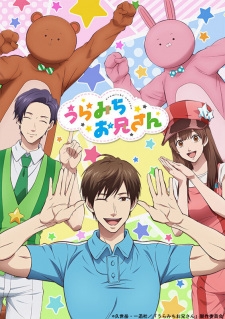
Uramichi Oniisan themes and satire hit different because they refuse to look away from the ugliness. You see this pink and blue cartoon aesthetic, you hear the bouncy opening theme 'ABC Taiso' performed by Mamoru Miyano and Nana Mizuki, and you think you're getting into some feel-good slice-of-life garbage about a guy who loves kids. Wrong. Dead wrong. This show is about a 31-year-old former gymnast who is rotting inside while forcing toddlers to do jumping jacks on national television.

The central gag isn't complex but it cuts deep. Uramichi Omota works on 'Together with Maman,' a direct parody of the long-running NHK program 'Okaasan to Issho.' He's supposed to be the cheerful 'Oniisan' who leads exercise segments. Instead he's giving these dead-eyed monologues about how rent is due and his back hurts and nothing matters. The kids ask innocent questions like 'Are you happy?' and he tells them the truth. He tells them adulthood is a trap. The camera crew keeps filming. The director doesn't stop him. That's the job.
The Mask Is Literal and It Itches
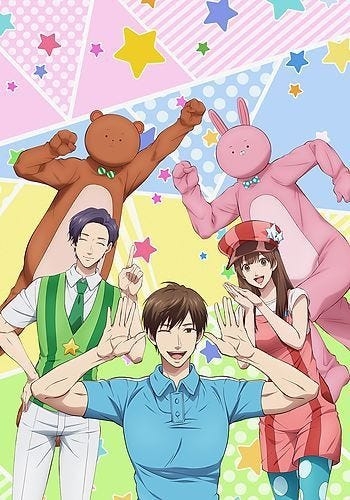
You can't talk about this show without addressing the masking. And I don't mean the psychological concept, though that's there too. I mean the literal mascot costumes. Tobikichi Usahara and Mitsuo Kumatani play Usao the rabbit and Kumao the bear. They're sweating inside these foam suits while Uramichi freezes his hands off putting them inside Usahara's costume during winter beach shoots. The physical discomfort is real. The Anime Inferno review points out how these moments create a parody of children's programming that extends beyond just the dialogue. It's about the body breaking down while the face stays smiling.
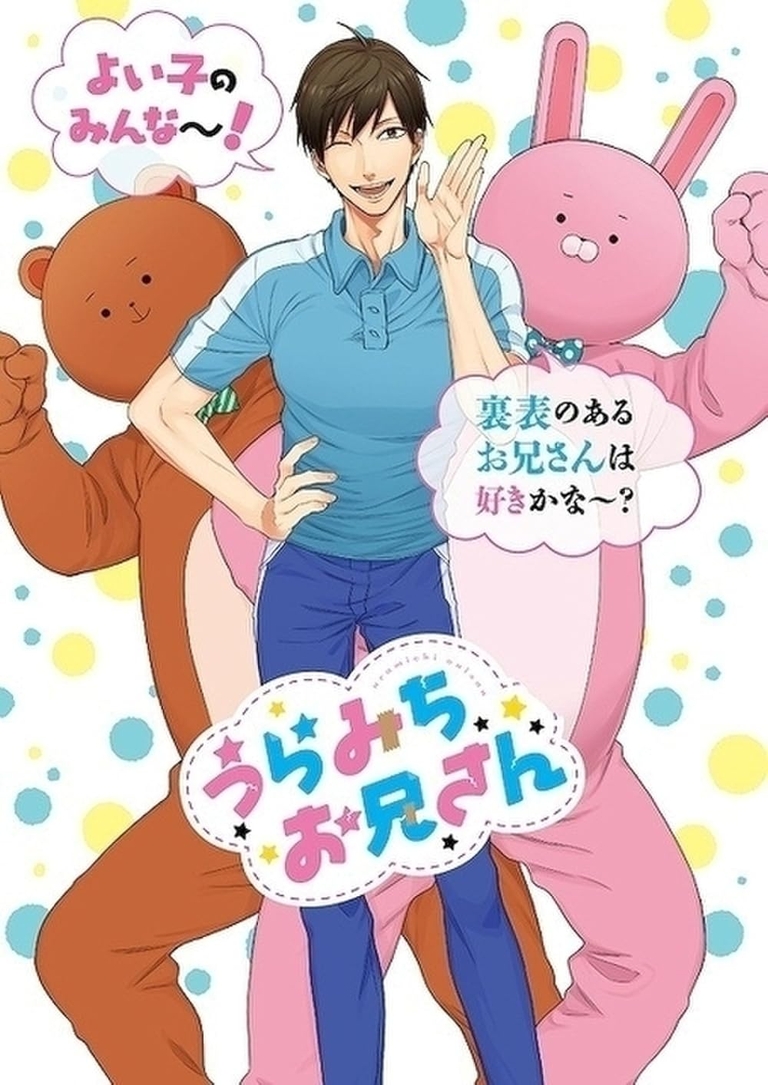
But yeah, the psychological masking is the whole point. Uramichi puts on that tracksuit and becomes 'Oniisan' for the cameras. Off-camera he's smoking, drinking, and doing pushups at 2 AM because he can't sleep. The show presents this duality without resolution. There's no episode where he learns to love his job. There's no arc where he quits to follow his dreams. He tried that. He was an Olympic-level gymnast. Now he's here. The satire works because it refuses the redemption narrative. Work doesn't make you free. It makes you tired.
Children's Television as Corporate Gulag
The specificity of the satire matters. This isn't generic 'office bad' humor. It's attacking the Japanese children's entertainment industry with surgical precision. 'Together with Maman' films summer music videos in the dead of winter. The cast freezes while pretending to enjoy watermelon. They sing songs with titles like 'Arm Through the Neck Hole' and 'The Free Sample Tasted So Good, So Why Was It Just Normal When I Got It Home?' The absurdity isn't random. It mirrors the actual surrealism of children's programming where adults perform manic happiness for an audience that will forget them in five years.
The director, Tekito Derekida, is incompetent and irresponsible. The choreography is handled by Furitsuke Capellini, who has his own weird obsession with Usahara. The assistant directors are overworked. Everyone is one missed paycheck away from disaster. The TV Tropes page for the series notes how this creates a backstage dramedy where the machinery of entertainment is exposed as cruel and ridiculous. You see the crew manipulating these broken adults into performing joy they don't feel. It's exploitation presented as comedy because if you don't laugh you'll realize you're watching a documentary about labor rights violations.
The Economics of Failed Dreams
Every character on this show is a cautionary tale about what happens when you bet on your passion and lose. Uramichi had athletic promise. Utano Tadano went to a prestigious music college and tried to be an idol, an enka singer, everything. Now she's stuck dating an unpopular comedian and screaming about wanting to get married. Iketeru Daga is beautiful and was a musical actor but he's functionally illiterate, can't read analog clocks, and laughs at words containing 'chin' (or 'Dick' in the English dub, which the localization team handled through clever recontextualization). He's too stupid to be depressed but he's also too stupid to succeed.
This is the millennial burnout anime. The IMDb entry describes it as venturing into horror territory and that's accurate. These aren't teenagers in high school figuring out their feelings. These are adults in their late twenties and early thirties who have already failed. The window closed. Now it's about endurance. The show finds its darkest humor in the contrast between the childhood dreams the characters were sold and the adult realities they're trapped in. Uramichi tells kids to follow their dreams while knowing exactly where that leads. It leads to him.
Workplace Trauma Bonding
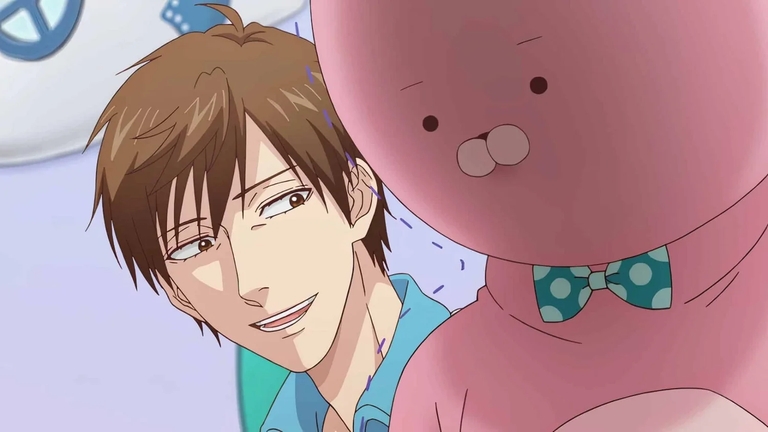
The relationships between the cast members form the only warm element in an otherwise freezing show. And even that's dysfunctional. Usahara gets physically and mentally abused by Uramichi constantly. Uramichi puts his cold hands in Usahara's bunny suit. He threatens him. He takes out his frustrations on the rabbit. But Usahara understands Uramichi better than anyone else. He was Uramichi's kouhai in college gymnastics. He knows what Uramichi lost.
Then there's Kumatani, who plays the bear. He's stoic and protective, especially of Iketeru. He shields the pretty idiot from exploitation. He participates in matching t-shirt gags. The Blogunderalog review calls Kumatani 'best boy' and I'm not arguing. The point is that these people aren't friends because they like each other. They're friends because they're in a foxhole together. The children's show is the foxhole. They commiserate about rent, about marriage pressure, about the horror of aging. They find solidarity in shared misery.
The Localization Choices Expose the Absurdity
The English dub deserves special mention because it doesn't try to be faithful in a boring way. It goes hard on the meme potential. Iketeru's character in the original Japanese laughs at words containing 'chin' (slang for penis). The English dub changes this to him laughing at names containing 'Dick.' They use real celebrity names. They make him laugh at Richard Feynman. It's stupid and juvenile and it works perfectly because Iketeru is stupid and juvenile. The dub also keeps some Japanese phrases like 'daijoubu' and 'genki' but throws in portmanteaus like 'ohayo gozai-morning.'
This Woolseyism, as TV Tropes calls it, actually enhances the satire. It highlights how ridiculous the premise is by treating the language with the same irreverence the characters treat their jobs. The Medium article about life lessons in the show mentions how the contrast between the cheerful facade and dark reality is the core theme, and the dub leans into that dissonance with its weird energy.
Where the Satire Stumbles
Not everything lands. The character Furitsuke Capellini is a choreographer who has a crush on Usahara. According to the Reddit discussion on queer representation in anime, Capellini is cited as a negative example. He's got limited screentime, stereotypical traits, and his attraction to Usahara is played as uncomfortable rather than genuine. The show is smart about workplace alienation but clumsy here. It uses queer coding as a punchline in a way that feels dated.
This is worth mentioning because the rest of the show is so sharp. When you're doing satire this precise, the moments where you fall back on lazy tropes stand out more. Capellini isn't a character so much as a walking joke about 'the weird gay guy who hits on the straight dude.' In a show that's otherwise about the complexity of adult relationships, this stands out as shallow.
The Horror of the Cyclical
Uramichi Oniisan doesn't have a plot arc. It's episodic. Uramichi starts depressed, has small moments of connection or absurdity, and ends up depressed again. The lack of progress is the point. The Medium analysis about finding meaning in the mundane tries to frame this as 'resilience' but I think that's being too generous. This isn't about resilience. It's about the trap of capitalism and the lie of upward mobility.
Uramichi doesn't get better because there's no mechanism for him to get better. He can't quit. He has no skills outside gymnastics. He's 31, which in Japanese corporate culture is ancient. The show is honest about how work grinds you down until your only hobbies are drinking and weight training because those are the only things you can control. The 'life lessons' he teaches the kids aren't lessons. They're warnings. He's trying to tell them to stay children forever because he knows what's coming.
Why Salarymen See Themselves in This
The reason this show hits hard for working adults, especially in Japan but really everywhere, is that it captures the specific texture of white-collar despair. It's not dramatic. It's not cinematic tragedy. It's waking up and realizing you've been wearing the mask so long you don't know what your real face looks like anymore. The Wikipedia entry compares it to Sayonara Zetsubou-Sensei, another black comedy, but Uramichi feels more grounded. Zetsubou-Sensei is surreal. Uramichi could be filming in a studio down the street.
The MyAnimeList reviews emphasize this relatability. People watch Uramichi and see their own commute. They see their own fake smile at the office. The show doesn't offer solutions because there aren't any. That's the satire. The children's show format promises that life is simple and good wins. Uramichi interrupts that broadcast to tell you that good doesn't win. Good gets tired. Good has to pay rent.
The Physical Comedy of Despair
Despite all this heavy thematic weight, the show is funny. It's loud, cackling funny. Uramichi's deadpan delivery while children stare at him in confusion is perfect comedic timing. The mascot costumes getting caught in doors. The forced smiles during increasingly ridiculous segments. The way Kumatani finally snaps and forces the director to wear the bear costume. These moments of catharsis work because they're earned. You feel the frustration building, so when it explodes into slapstick, it's satisfying.
The Anime Inferno review notes how the English voice actors deliver these moments through 'meme-like' dramatic readings. The physical suffering of the actors on set, filming in freezing weather or sweating under lights, translates to physical comedy that has real bite. It's not just pratfalls. It's pratfalls as existential scream.
The Uncomfortable Holiday Watch
CBR called this the ultimate holiday watch four years ago, which seems weird until you think about it. The holidays are when the pressure to be happy is strongest. Everyone's supposed to be with family, full of joy, grateful. Uramichi Oniisan is for the people who hate that pressure. It's for the people sitting alone in apartments watching TV and wondering why they can't feel what everyone else seems to feel. The show validates that the holiday season, like childhood itself, is often a performance that hides real suffering.
Uramichi Oniisan themes and satire work because they refuse to comfort you. They show you a man breaking and they don't fix him. They show you a workplace that grinds people down and they don't shut it down. They just keep filming. The camera keeps rolling. And Uramichi keeps smiling that dead smile, leading the ABC exercise, telling kids that life is tough while the producers count their money. It's funny because it's true. And it's terrifying for the exact same reason.