
Tsukimonogatari arc analysis usually misses the point by calling it filler. Yeah, it's only four episodes. Yeah, it happens right after the emotional peak of Hitagi End. But dismissing it as a waste of time ignores how it traps Araragi in the exact moment he needs to be trapped. The guy looks in a mirror, sees nothing, and still thinks he can fix everything by getting hurt again. That's not lazy writing. That's the whole trap.
The arc starts twelve days after Kaiki limped out of town. Araragi's supposed to be studying for college exams. Instead he's taking baths with his sisters and noticing he doesn't cast a reflection anymore. Shinobu tells him straight up. He's used his vampire healing too many times. The regeneration isn't just fixing him anymore. It's replacing him. Every time he let his arm get ripped off or his guts spilled out for some girl, he was trading more of his humanity for convenience. Now he's stuck at a tipping point where one more injury might flip the switch completely. He'll become a full vampire, lose his human life, and probably get hunted down by specialists who kill immortal oddities.
But Araragi doesn't stop. He can't. That's the annoying part that makes this arc work.
When the Mirror Shows Nothing
The no-reflection thing isn't just a cool visual gag. It's Araragi's identity literally disappearing because he keeps treating his body like a disposable tool. He's spent the entire series throwing himself in front of attacks, assuming Shinobu's power will patch him up. He saved Senjougahara, he saved Hachikuji, he saved Kanbaru, he even tried to save Nadeko when she didn't want saving. Every rescue cost him something he couldn't see until now.
Shinobu sits in his shadow looking worried, which is weird for her. She usually eggs him on. But even she knows this is different. If he transforms completely, she gets her full power back, but she also loses the weird half-relationship they've built. She doesn't want a servant. She wants the idiot who buys her donuts. So she points him toward Kagenui, the specialist who walks on air and hates immortal things.
Kagenui shows up at the ruined cram school, which keeps changing backgrounds like a screensaver. One minute it's snowing inside, next minute it's an ice palace, then it's just concrete again. The location refuses to stay literal, which fits because nothing in this arc is grounded. Araragi's condition is theoretical until it isn't. Kagenui breaks his fingers to test his healing, and he fixes them instantly by thinking about Hanekawa's chest, which is probably the most honest he's been about his motivations in weeks.
She tells him there's no cure. He can't go back to being a normal human. The best he can do is freeze the process by never using his powers again. Stop healing. Stop fighting. Stop helping. Just study for exams and ignore everyone who needs him. That's the only way to stay human.
Araragi agrees immediately, which you know is a lie because you've watched thirty episodes of this guy. He'd rather die than stay out of other people's business.
Yotsugi and the Act of Being Human

Ononoki Yotsugi gets the spotlight here, and she's weird in a way that actually matters. She's a tsukumogami, a possessed doll, a corpse animated by magic. She acts like a robot on purpose. She speaks in flat monotones and does the "Unlimited Rulebook" catchphrase like she's reading a script. But here's the thing. She's not actually emotionless. She's just pretending really hard.
There's this whole thing about the shoe analogy that gets discussed in the arc. Yotsugi wears shoes even though she doesn't need them. She imitates human behavior because that's how she interacts with the world. Apparitions don't have fixed forms. They exist because people perceive them. So Yotsugi chooses to look like a cute doll and act like a weird automaton because that's how Araragi and the others can understand her. She's lying about being a monster so she can have conversations without breaking people's brains.
This connects back to Araragi's problem. He's been lying too, but in the opposite direction. He keeps pretending he's human while using vampire powers every chance he gets. Yotsugi is honest about her dishonesty. She knows she's faking humanity to bridge the gap between species. Araragi thinks his good intentions make his hypocrisy okay. The arc puts them side by side in the snow so you can see the contrast.
The snow matters here. It keeps falling during their conversations, covering everything in white coldness. Some people say this visual choice represents Yotsugi's true nature, which is cold and inhuman beneath the cute exterior. I think it's simpler than that. Snow covers tracks. It hides the ground. It makes everything look clean and blank even when the dirt is still underneath. Araragi wants his life to be that snow. He wants to look pure while hiding the damage he's doing to himself.
The Specialists and Their Dead Ends
Kagenui and Tadatsuru Teori represent the consequences Araragi's been avoiding. They're both oddity specialists who became cursed by their own work. Kagenui can't touch the ground. She walks on air or furniture or people's faces, never the earth itself. Tadatsuru can't touch the ground either, which is why he floats around making origami at the shrine.
Tadatsuru shows up as the villain for about fifteen minutes. He kidnaps Karen, Tsukihi, and Kanbaru to force Araragi into a confrontation. But he's not really evil. He's just doing a job, or maybe he's being manipulated by Gaen like everyone else. The important part is how he dies. Yotsugi kills him. She crushes him without hesitation, and Araragi watches a monster kill a man who was trying to kill him.
This breaks their friendship, or at least changes it. Araragi can't look at Yotsugi the same way after seeing her murder someone efficiently. She stops being the cute doll from the crane game and becomes something dangerous that happens to wear a hat. According to some analyses, this is the point. Yotsugi shows Araragi what he looks like from the outside. A monster pretending to help people while actually just destroying things.
Tadatsuru accepts his death weirdly calmly. He asks Yotsugi to do it. He says he's been dead for a while anyway, working with corpses and spirits. Before he goes, he warns Araragi that someone is pulling strings behind everything. He mentions Oshino, which plants a seed for later arcs. Then he dies, the hostages get rescued off-screen, and everyone goes home.
It feels anticlimactic because it is. That's the point. Real consequences don't come with epic music and final boss forms. They come sudden and ugly, and you don't get to punch your way out of them.
Visual Noise and Color Explosions

Shaft went nuts with the visuals in this one. The color palette shifted hard from the warm nostalgic tones of early Monogatari to neon vomit. The cram school scenes look like someone dumped highlighters in a blender. Yellows, blues, purples, all glowing like they're radioactive. One review pointed out that this clashes with the series' usual aesthetic, making everything feel fake and artificial.
I think that's intentional. Araragi's perception is breaking, so the art breaks with it. The backgrounds shift during conversations without cuts. Characters teleport between locations while talking. The snow glows white-blue like it's LED-powered. Nothing feels solid because Araragi's sense of self isn't solid anymore.
They also introduced those newspaper flash cards with ripped edges and text overlays. The wiki notes) this became a staple for Final Season. Instead of just flashing black screens with red text, they used scrapbook paper with sound effects. It looks like someone attacked a middle school diary with scissors. Some people hate it. I think it fits the arc's messy, collage-like quality. Araragi's life is literally falling apart and being taped back together with bad decisions.
The animation itself got an upgrade though. Character movements are smoother. The bath scene with Karen and Tsukihi has more frames than some entire episodes of Nisemonogatari. Whether that's a good use of budget depends on how much you wanted to see Araragi get pushed around by his sisters again.
The Bathtub and the Problem of Nisemonogatari Echoes
Speaking of that bath scene, yeah, it's annoying. The arc opens with Araragi getting into a tub with Tsukihi, which feels like a regression to the worst parts of Nisemonogatari. Karen shows up, violence happens, fanservice happens, and you're sitting there wondering why we're doing this after the emotional maturity of Second Season.
One review called it gratuitous and repetitive, saying the Fire Sisters are the least likable characters and this just reminds you why. I don't think it's pointless though. It's showing Araragi refusing to change. He's still playing the goofy pervert older brother because that's easier than facing the fact that he's becoming a vampire and going to college. He wants to stay in high school forever, messing around with his sisters and ignoring his future.
The scene where he stares up Yotsugi's skirt for ten minutes while climbing the mountain is more of the same. He's performing his old self, the horny idiot who can't help himself, because if he stops performing it, he has to become something else. Something scarier.
But I get why people check out here. After watching Hanekawa overcome her trauma and Senjougahara beg for help and Nadeko confront her own delusions, going back to Araragi's static character feels like a step backwards. Wrong Every Time noted that Araragi works best with dynamic companions, but Kagenui and Yotsugi are too reserved to push him properly. The chemistry is flat, so the arc drags even though it's only four episodes.
The Promise That Can't Be Kept
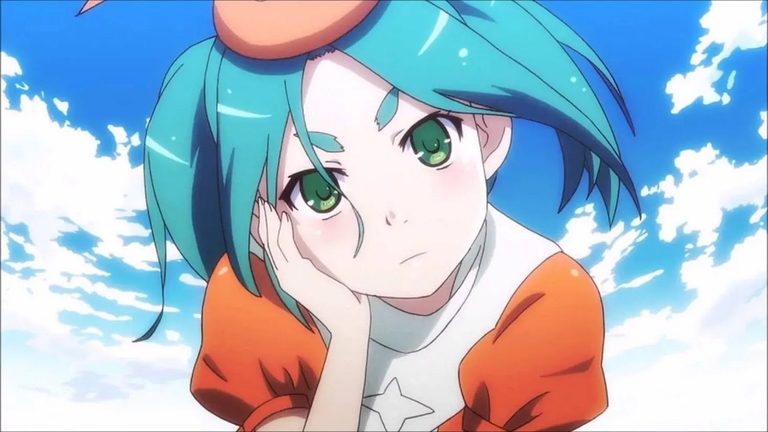
The central conflict crystallizes when Yotsugi makes Araragi promise not to use his vampire powers anymore. She frames it as a friend asking a friend to stay human. He promises, knowing full well he's going to break it. The moment his sisters or Senjougahara or anyone else is in danger, he'll heal himself again. He can't stop.
This is where the perception theme becomes important. Araragi sees himself as a hero who saves people. Everyone else sees him as a vampire who doesn't know when to quit. The gap between those perceptions is killing him, literally. He thinks he's being selfless, but he's actually being selfish by refusing to let other people handle their own problems. He wants to be needed so badly that he'll destroy himself to maintain that need.
Kagenui threatens to kill him if he transforms. Shinobu threatens to kill Kagenui if she tries. Yotsugi just looks sad because she knows promises between monsters and humans don't work. She's been there. She knows what it's like to pretend you're something you're not until the pretending becomes the only real thing about you.
The arc ends with Araragi technically winning. He saves everyone, doesn't fully transform, and gets to keep living his double life. But he loses Yotsugi's friendship in the process. She moves into his house as a surveillance doll assigned by Gaen, but their dynamic is broken. He saw her true nature, and he can't unsee it. She becomes furniture, literally appearing in crane games at the arcade and getting won by Karen and Tsukihi.
Valentine's Day and the Illusion of Progress
The final scene hits different after all this. Araragi visits Senjougahara on Valentine's Day. She feeds him chocolate. She's kind and gentle in a way that would have been impossible in Bakemonogatari. She's grown. She's changed. She faced her past with Kaiki and came out softer but stronger.
Araragi hasn't changed at all. He's still the same guy who saved her from the weight crab, still dependent on vampire powers, still unable to see his own reflection in the mirror. She loves him anyway, which is sweet but also tragic. She's growing up and moving forward while he's stuck in a snow globe, repeating the same heroic cycle until it kills him.
Some fans call Tsukimonogatari filler because it doesn't advance the main plot much. Tadatsuru dies, but he was barely introduced. The vampire threat gets tabled for later. Ougi shows up to be cryptic for five minutes. Nothing gets resolved. But that's exactly what the arc is about. The inability to resolve things. The inability to grow up. Araragi is trapped in a four-episode loop of his own making, and the snow keeps falling to cover up the fact that he's running in place.
Is it the weakest arc? Maybe. Some reviews definitely think so. The dialogue circles around itself. The villain appears and disappears too fast. The fanservice feels dated. But it serves a necessary function as a warning. Araragi's story can't end well if he keeps this up. The monster is him, and he's looking right at it every time he avoids his reflection.