
Tsukimichi: Moonlit Fantasy world explained properly means starting with the fact that the Goddess running this place is completely biased and kind of terrible at her job. She summons people from Earth to be heroes, decides Makoto Misumi is too ugly to be the main character, and throws him off the edge of the world like garbage. That one petty decision breaks everything about how this fantasy setting is supposed to function, and it is hilarious to watch.
You have probably seen the anime and thought the world seemed like standard isekai fare with demons and dragons and magic guilds. You are wrong. This place is held together by spit, divine favoritism, and time travel paradoxes that give me a headache. The geography is literally shaped like Japan for no good reason, the economy runs on coins worth way too much yen, and the level system was cribbed from a fantasy novel that might not have been written yet. I am going to break down exactly why this world is a mess and why that makes it interesting.
Why the Goddess World is Broken by Design
The so-called Goddess' World is technically called Elysion by some people, but mostly everyone just calls it the Goddess' World because she controls everything while being bad at her job. She did not even create the place alone. She had help from the Greater Dragons, ancient super powerful beings who were already there, and together they built the continents and populated them with races. The Goddess made the Hyumans in her own image, decided they were the best looking, and has been playing favorites ever since.
This bias is not just annoying, it is the driving force behind every major conflict. The Goddess actively supports the Hyumans in their war against the Demons, sending heroes from Earth to help them win. She gives Hyumans beauty, language comprehension from birth, and power boosts just for existing. Meanwhile she dumps every other race into the wastelands or treats them like monsters. Makoto gets banished to the literal edge of the map because he does not meet her beauty standards, which tells you everything about her priorities. She is not governing a world, she is curating an Instagram feed.
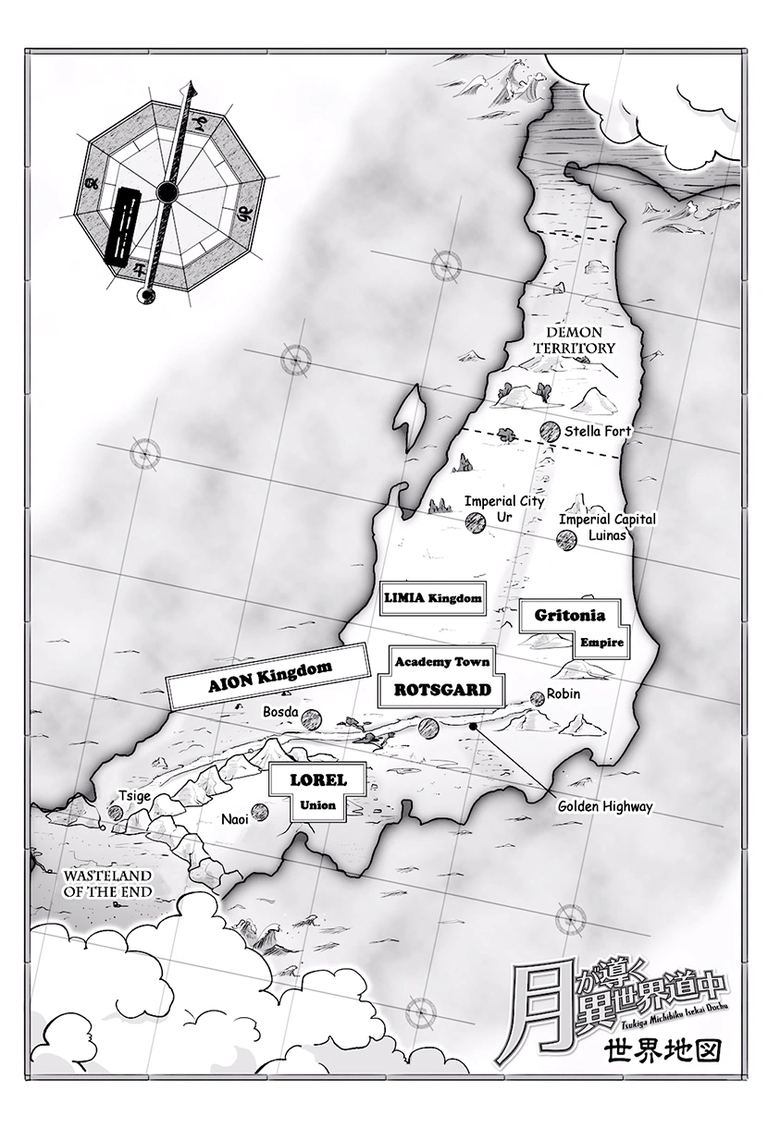
The world itself is one continent shaped like Japan, which is weird and never fully explained beyond maybe the Goddess liked how Japan looked. You have the Limia Kingdom acting like European nobility, the Aion Kingdom looking like the Japanese Shogunate era, and random noble houses with Japanese cultural influences scattered around. It is a grab bag of aesthetics that should not work together but do because magic holds it together. The technology level is stuck somewhere between medieval and early modern depending on the region, and apparently even grade school math is considered advanced education here.
The Geography and Its Stolen Layout
Looking at the map of the Goddess' World is confusing because you recognize the shape immediately if you know Japanese geography. The continent mirrors Japan's shape, with the Demon Territory occupying the northern regions and various human kingdoms filling in the rest. The Wasteland sits at the western edge where Makoto gets dumped, a harsh survival zone full of dangerous monsters and forgotten races the Goddess does not care about. Academy Town Rotsgard sits somewhere in the middle as a neutral research hub, and Tsige exists as a frontier merchant city that might as well be the Wild West.
The Demon Territory includes fallen regions like Elysion, which was one of the first countries to fall in the war, and Kaleneon, a satellite state that gets liberated later. Fort Stella used to be a frontier fortress before it got destroyed. You have got the Lazuli Volcano where Greater Dragons hang out, and various other locations that feel like they were placed by throwing darts at a map of Japan. The terrain varies wildly from place to place, with magic affecting the climate and geography in ways that make no meteorological sense.
Travel between these places is complicated by the presence of monsters, the ongoing war, and the fact that some locations exist in alternate spaces. Mist Town is not technically in the same dimension as the rest of the world, existing in a place called Asora which Makoto controls. The Wasteland borders the edge of the world where the Goddess literally threw Makoto, suggesting the world might be flat or at least has a very defined edge where her influence wanes. Getting around requires adventurer guild certification, mercenary escorts, or being powerful enough to kill everything that moves.
Time Travel Headaches You Did Not Ask For
Here is where Tsukimichi: Moonlit Fantasy gets weird compared to other isekai stories. The time difference between Earth and the Goddess' World is not a simple ratio like one day here equals one year there. It is completely nonlinear and broken. Makoto's father spent thirty years on Earth after leaving the Goddess' World thirty years prior by that world's reckoning. But the heroes from two thousand years ago in the Goddess' World only came from twenty years ago on Earth. That is not a time dilation, that is a time pretzel.
Apparently the spell used to summon people is a time-space displacement spell, not just teleportation. This means when you travel between worlds, you are also sliding along the timeline in unpredictable ways. The Reddit users who analyzed this got it right when they called it wibbly-wobbly timey-wimey stuff. There is a paradox where Makoto's father might have written a fantasy novel on Earth that inspired an RPG, which the heroes brought to the Goddess' World, which inspired Root to create the level system, which then inspired the novel that Makoto's father wrote. It is a closed causal loop that makes my brain hurt.
What this means practically is that Makoto cannot just go home. Even if he finds the right spatial coordinates to return to Earth, he has to calculate the exact temporal coordinates too. He could arrive the day after he left, or he could arrive a hundred years before he was born, or he could land in the dinosaur era. Gods can bypass this using portals and special tools, but for everyone else it is nearly impossible. The bridge between worlds determines the temporal alignment, not the time elapsed in either world. So worrying about how many years passed in the Goddess' World is pointless because the connection could link to any point in Earth's timeline.
Hyumans are the Worst and the Goddess Loves Them
The Hyumans are basically humans but prettier and more arrogant. The Goddess made them attractive by her standards, gave them the ability to learn the Common Language as infants, and blessed them with power boosts. She considers them the superior race despite the fact that they are losing the war against the Demons and constantly need heroes summoned from other worlds to bail them out. They live in kingdoms like Limia and Gritonia that function like standard European fantasy nations with nobles and royalty and all the usual political backstabbing.
The Goddess picks heroes based on looks, not competence. Tomoki and Hibiki get summoned as replacements for Makoto because they are pretty, and she basically kidnaps them to serve her favorite race. She loses the respect of other gods for this move, but she does not care because she is obsessed with aesthetic perfection. Hyuman society reflects this shallow value system, with beauty correlating to status and opportunity. Polygamy is common and accepted, with men taking multiple wives, which seems convenient for the Goddess' plan to have her heroes breed strong bloodlines.
The education level among Hyumans is embarrassingly low. Makoto notes that the merchant tests are so simple that an elementary school student from Earth could pass them. They rely on blessing-based language comprehension rather than actual learning, and their understanding of magic, while functional, lacks the theoretical depth that someone like Shiki or Makoto can bring. They are a society of magical dependents who never had to innovate because the Goddess handed them everything on a silver platter, which is why they are struggling against the Demons who had to actually work for their power.
The Level System and Why Makoto Broke It
The level system in this world works like an RPG because Root, the leader of the Greater Dragons, created it that way after being inspired by stories from Earth heroes. It uses standard copper, silver, gold, and platinum rankings for adventurers, with levels capping at 65,536 because that is the integer limit Root decided on. Most people progress slowly through this system, gaining stats and abilities as they level up from killing monsters and completing quests.
Then Makoto shows up. Tsukuyomi, the Moon God, gives Makoto all his power before Makoto even arrives in the world. This bypasses the level system entirely and causes an integer overflow where Makoto's stats exceed the maximum limit. He effectively becomes a deity in terms of power level while still technically being level 1 or having no level at all. He cannot use the standard appraisal crystals because they break when they try to read his stats. The system was not designed to handle someone with god-tier mana reserves and physical abilities.
This creates practical problems for Makoto. He has to wear special gear crafted by Beren the dwarf to suppress his aura, otherwise he accidentally intimidates everyone around him or breaks things just by existing. He cannot integrate into normal Hyuman society because he is too powerful to register on their scales. The level system that defines social status and military capability in this world simply does not apply to him, which forces him to operate outside the normal structures as a merchant named Raidou Kuzunoha instead of as a proper hero.
Asora: The Real Protagonist of This Story
Asora is Makoto's demiplane, a pocket dimension that exists outside the Goddess' World. Tomoe, formerly the Greater Dragon Shen, creates it using her illusion mists after forming a contract with Makoto. It starts as a blank slate but quickly becomes a thriving civilization populated by various races that Makoto rescues from the Wasteland or other bad situations. You have got orcs, dwarves, elder dwarves, alkes, forest oni, and later highland orcs and mist lizards all living together in this alternate space.
The logistics of Asora are weird because it operates on Makoto's mana and follows different rules than the main world. Crops grow faster, the environment reshapes itself based on Makoto's subconscious desires, and it serves as a safe haven completely outside the Goddess' influence. Mist Town is the entrance point where they conduct trade with the outside world, selling goods produced in Asora through the Kuzunoha Company. It is basically a cheat base that becomes more important than any of the kingdoms in the main world.
Within Asora, Makoto is the absolute ruler though he pretends to be a merchant. Emma the orc handles day to day management, while various other lieutenants handle specific departments like cooking or blacksmithing. The place becomes a technological and magical powerhouse because they combine Earth's knowledge, brought by Makoto, with the magical resources of the fantasy world. They build hot springs, develop new agricultural techniques, and basically create a utopia while the rest of the world is busy fighting a stupid war over the Goddess' beauty standards.
Demons Got the Short End of the Stick
The Demons are not actually demons in the traditional fantasy sense. They are just another race that the Goddess decided were ugly or undesirable, so she labeled them enemies of the Hyumans. They live in the northern territories and have been fighting a defensive war against the Hyumans and their summoned heroes for generations. Unlike the Hyumans, they did not get divine blessings or easy language comprehension, so they had to develop their own magic systems and society from scratch.
Because the Goddess actively supports the Hyumans with divine magic and hero summons, the Demons have had to become stronger through actual effort and strategy. They develop advanced tactics, powerful individual fighters, and a society that values competence over beauty. They are not evil, they are just the side that the Goddess does not like, which makes them sympathetic. When Makoto finally meets them, he finds they are often more reasonable than the Hyumans.
The Demon Army includes characters like Sofia Bulga, who is a skilled adventurer type working with the Demons, and various other powerful beings who could not fit into Hyuman society. They have their own territories and cities that function perfectly well without the Goddess' blessing, proving that her management is unnecessary at best and harmful at worst. The war is essentially a vanity project for a deity who wants her favorite pretty people to win, and the Demons are the underdogs fighting against divine favoritism.
Why You Cannot Just Go Home Again
The complications of inter-world travel in Tsukimichi are ridiculous. You cannot just find a portal and step through to Earth. You have to solve for time as well as space, and doing the math requires god-level processing power. Root explains to Makoto that even if he could locate the spatial coordinates for Earth, he would need to pinpoint the exact temporal coordinates to avoid landing in the wrong century. The spell that brought him here moved him through time as well as space, and the connection between the worlds is constantly shifting.
Gods can travel between worlds using specialized tools and portals that bypass these limitations, which is how Tsukuyomi sent Makoto and how the Goddess summons heroes. But for a mortal, even an incredibly powerful one like Makoto, the calculations are nearly impossible. The bridge between worlds acts like a moving target, connecting different time periods randomly. Makoto's parents got lucky with their timing, but they might have created a separate timeline or arrived at different points in Earth's history.
This means Makoto is effectively stuck. He can become powerful enough to challenge the Goddess herself, which seems to be the plan the other gods have for him, but he cannot simply retire back to Japan and pick up his old life. He has to build a new life in the Goddess' World, creating Asora as his own little piece of sanity while the rest of the world tries to figure out why one ugly guy is ruining their carefully curated hero system. The world explained here is one where the rules are arbitrary, the gods are petty, and the only way to win is to break the system entirely.
Tsukimichi: Moonlit Fantasy world explained comes down to this: it is a poorly managed simulation run by a deity with bad priorities, held together by dragons who are tired of her nonsense, and currently being broken by a guy who was supposed to be a throwaway character. The geography makes no sense, the timeline is broken, and the level system has an integer overflow error walking around in human form. That is why it is fun to watch.