
The Seven Deadly Sins Revival of the Commandments hits you with a solid opening that makes you think you are in for something tight and focused. Meliodas dies at the end of the first episode, killed by Estarossa in a genuine shock moment that lasts about five minutes before you realize death means nothing in this show because he has a curse that revives him constantly. This season covers the Ten Commandments arc where ten demon elites wake up after three thousand years and start eating human souls to regain their magic power, and it should feel scary like the stakes got real but instead you get characters shouting numbers at each other while a guy named Escanor shows up to save everything from mediocrity.

First you need to understand the Netflix numbering mess because it confuses everyone who tries to watch this show in order. Revival of the Commandments is the true second season, not the Signs of Holy War four episode special that Netflix labeled as season two for some reason that makes no sense to anyone who follows the production. Signs of Holy War is filler fluff that you can skip entirely unless you have a terrible memory and forgot who Diane is or what the capital city looks like. Revival starts with episode one of this arc and runs twenty four episodes straight through to the big team up battle at the end, and you will want to make sure you start here because starting with the recap special will bore you to tears with repeated footage from season one.
Why the Power Level Scanner Ruined Everything
The biggest problem this season introduces is the power level scanner that Merlin pulls out of nowhere like she is selling insurance to the audience. She uses a magic eye that assigns numerical values to everyone based on their magic strength, physical power, and willpower combined into one total number, and suddenly every fight becomes a spreadsheet that kills tension faster than Galand's critical over ability kills side characters. You will watch Galand dance around Britannia with a power level of twenty six thousand while Meliodas sits at three thousand four hundred and the show expects you to believe this gap is insurmountable even though you have watched shonen anime before and know the good guy always finds a way to win regardless of the math.
It kills suspense dead because you know exactly who will win before the first punch is thrown based on who has the higher number on the floating display. High numbers beat low numbers unless the plot needs someone to unlock a hidden form or rage mode, then the numbers get higher and the display breaks or shows infinity or some other nonsense that makes you wonder why they introduced the system in the first place. It is Dragon Ball Z scouter mechanics without the charm of Vegeta screaming about it being over nine thousand, and it turns every battle into a comparison of integers rather than a contest of skill or strategy or emotional weight. You will find yourself bored during supposedly intense moments because the numbers told you the outcome five minutes ago and watching the weaker character struggle against the inevitable feels like padding rather than drama.
Escanor is the single reason this season remains watchable despite the math homework ruining the other fights. He shows up halfway through the run introduced as a weak scrawny bartender who apologizes for existing during the night and sweats nervously whenever anyone looks at him. Then the sun rises and he transforms into a seven foot tall mountain of pure arrogance who wields a giant axe named Rhitta and believes with absolute certainty that he is the strongest being in existence, and the twist is that he is completely right about that assessment. The show gives him a power level that literally says immeasurable on Merlin's scanner and it is the smartest decision they make because it breaks the scale that was suffocating the rest of the cast under rigid numerical hierarchies.
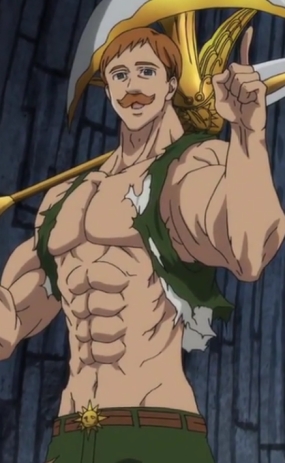
His fight against Galand is a squash match that lasts seconds and it is the best animated sequence in the whole batch of episodes because you do not see the numbers, you just see a demon who thought he was invincible getting one shot by a man glowing with sunlight. His fight against Estarossa later on destroys a castle and delivers the kind of raw spectacle that makes you forget the calculator app the show turned into for everyone else. When Escanor is on screen the show remembers that shonen fights are supposed to be about emotion and excess and impossible feats of strength, not addition and subtraction.
The Ten Commandments Are Just Bodies
The Ten Commandments themselves are a mixed bag that leans hard toward disappointing when you look at them as a group rather than individual designs. You have ten demon elites who served the Demon King directly and each carries a specific curse tied to a commandment like Truth or Love or Reticence or Pacifism, and these sound cool on paper with visual designs that range from creepy old men to giant women to fairy kings turned bad, but the show burns through them too fast to give them any real weight as threats. Galand turns people to stone if they lie to him which is terrifying until you realize he is an idiot who gets tricked by a literal child. Estarossa destroys the hearts of those who feel hatred toward him which makes him nearly invincible against angry shonen protagonists but the show keeps him sitting on the sidelines until the finale.
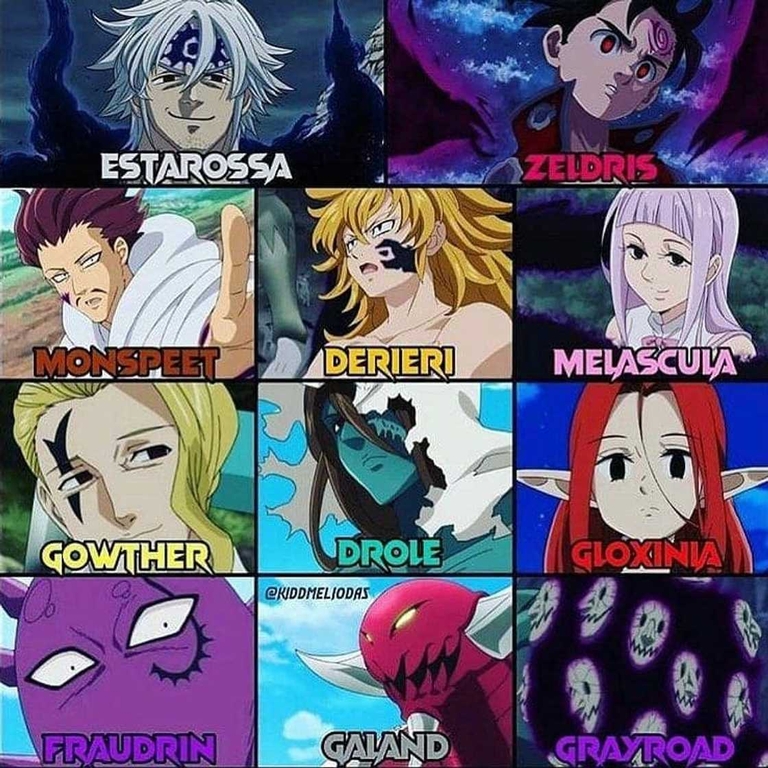
Half the commandments die or get incapacitated without getting any personality beyond their visual design and their one gimmick power. Derieri and Monspeet get a decent subplot about their loyalty to each other and their quiet moments of genuine affection that humanize them beyond being monster of the week villains, and Zeldris gets to be the serious younger brother who hates Meliodas for betraying the demons three thousand years ago, but most of them are just bodies for the Sins to punch until they stop moving. Fraudrin possesses Dreyfus for most of the season and serves as the main physical threat for the early episodes, but he is boring and his motivation is just generic demon rage without the tragic backstory elements that make villains interesting in this series. Grayroad has the pacifism commandment that ages people to death if they kill in her presence, which is a terrifying concept that gets used exactly once before she is captured and forgotten.
The show wants you to feel like these ten are an existential threat to all of Britannia but they spend most of the season sitting in a castle arguing with each other while the Sins run around doing side quests. They do not feel like a cohesive unit with a plan, they feel like ten random bosses who wandered in from different video games and decided to share a house. When they do fight, the power levels make their victories feel predetermined rather than earned through tactics or teamwork, which wastes the potential of seeing ten unique curse abilities working in tandem against the heroes.
Meliodas and His Family Drama
Meliodas gets a lot of focus this season regarding his past as the former leader of the Ten Commandments and the Demon King's eldest son, which sounds important but mostly translates to him getting his ass kicked and dying repeatedly while his girlfriend Elizabeth cries over his corpse. The show keeps hinting at his true power level which is supposedly way higher than the three thousand he displays, but he spends half the season dead or recovering from being dead or emotionally compromised because his curse makes him lose feelings every time he revives. His curse of immortality gets explained more deeply, revealing that he dies and revives constantly while losing emotions each time until he becomes a shell of himself, and it is supposed to be tragic but after the third fake out death where he comes back five minutes later you stop caring about the stakes.
His brother Zeldris makes for a better antagonist because he actually stays threatening without the show trying to make you sympathize with him every five seconds like it does with Estarossa. Zeldris has the commandment of Piety which forces anyone who turns their back on him to become a mindless servant, which is a horrifying power that he uses effectively in combat rather than just talking about it. The dynamic between the three brothers, Meliodas the traitor, Estarossa the middle child with a crush on Elizabeth, and Zeldris the loyal son trying to live up to their father's expectations, has genuine potential for emotional conflict, but the season only scratches the surface of it before ending on a cliffhanger that promises more family drama in the next batch of episodes.
Side Quests That Pad the Runtime
Ban gets sidelined into a weird subplot about trying to revive Elaine his dead fairy girlfriend which involves him leaving the group right when they need him most and wandering around the countryside with Jericho acting like his unwanted sidekick. Jericho used to be a villain in the first season who got turned into a demon by the weird smoke stuff, but now she has a crush on Ban and follows him like a lost puppy while he ignores her completely for the ghost of his girlfriend who appears to him in visions. It drags on for episodes and kills the momentum of the main conflict with the Ten Commandments because every time you cut back to Ban walking through a forest while Jericho stares at him longingly, you forget that the world is supposedly ending back in the capital.
Ban's backstory with his adoptive father Zhivago gets a solid emotional episode that hits harder than it should, showing how he learned to steal and fight as a kid and how Zhivago sacrificed himself to save Ban from the hunters, but mostly his arc this season feels like padding to keep him away from the main group so the power balance stays tilted toward the villains until the plot needs him to return. Diane gets hit with amnesia that makes her forget she is a member of the Seven Deadly Sins and forget that she loves King, which forces King to babysit her through a flashback arc about the giant and fairy clans three thousand years ago. It introduces Drole the giant king and Gloxinia the first fairy king who both used to be members of the Ten Commandments before they switched sides or died or whatever, and their designs are cool with Drole being a four armed muscle monster and Gloxinia looking like a creepy doll, but the flashback stops the main plot dead for three full episodes right when the Commandments are supposed to feel like an active threat breathing down the heroes necks.
It is classic shonen filler disguised as world building that gives you history you did not ask for instead of progressing the current conflict, and while the backstory is somewhat interesting it kills the pacing completely and makes you wonder why they chose now of all times to explore ancient history. King gets some development as he has to fight Gloxinia who represents what King could have become if he stayed bitter about his sister, but the emotional weight is undercut by the fact that you know Diane is going to get her memory back eventually and none of this side quest really changes the status quo.
Gowther's Creepy Backstory
Gowther gets his big reveal as a former Commandment who lost his memories and emotions because of a magical heart sacrifice or some nonsense, which explains why he acts like a robot who does not understand human social cues and wears weird lingerie outfits despite being a doll. His backstory with the princess Nadja is creepy and sad and gives him actual motivation beyond I like wearing weird clothes, showing how he tried to give her his heart to save her life because he loved her but ended up killing her instead because he did not understand how human bodies work. It is one of the better handled character beats this season even if it comes with more tragic backstory stacking that makes you wonder if every single character needs to be a reincarnated ancient warrior with a cursed fate tied to the Holy War from three thousand years ago.
The reveal that he was the original Gowther's creation, a doll given life by a demon sacrifice, complicates his relationships with the other Sins because he has been manipulating their memories without them knowing, including erasing Diane's memories multiple times to run experiments on emotions. The show tries to forgive him immediately because he is their friend, but if you think about it for more than a second he is a massive creep who violated his friends minds and the season glosses over that because he cries a little and says he is sorry.
Animation Peaks and Valleys
The animation by A-1 Pictures remains gorgeous for the big moments and fight scenes that matter to the plot. The color palette is bright and saturated with deep reds and golds that make the magic effects pop off the screen, and the character designs stay consistent with Nakaba Suzuki's manga art without getting simplified or off model too often. Escanor's transformation scenes get special treatment with lens flare and heat distortion that sells the idea that he is literally too hot to touch and emitting sunlight from his body, and the final battle where all seven Sins fight together uses fluid camera movement that makes the teamwork feel dynamic and coordinated.
However, some episodes clearly had less budget in the production schedule, with static shots of characters talking without any movement in the background and reused transformation sequences for the demons that get old fast. The CG used for Hawk's mom, the giant pig who carries the bar on her back, looks terrible and breaks immersion whenever she is on screen because she is a 3D model that does not blend with the 2D characters around her at all. There are moments where the power level displays are just white text on black backgrounds that look like they were added in post production by an intern, and some of the mid season episodes have faces that look slightly melted or off center.
The Soundtrack Situation
Hiroyuki Sawano returns for the music and mostly reuses themes from the first season with some new tracks sprinkled in that do not hit as hard as the classics. You will hear variations on Perfect Time and Drumstel during the fight scenes because those songs are associated with the brand now, but the new stuff lacks the memorable hooks that made the first season's score iconic. The opening theme Howling by Flow and Granrodeo is a banger that gets you hyped with its heavy guitar riffs and driving beat even when the episode attached to it is slow and boring, and the ending theme is forgettable but inoffensive. The voice acting remains solid in both sub and dub with Yuki Kaji selling Meliodas's occasional dark moments and Tomokazu Sugita bringing a perfect mix of pathetic weakness and overwhelming arrogance to Escanor that makes both versions of the character distinct and memorable.
Where Seven Deadly Sins Revival of the Commandments Leaves You
By the time you reach episode twenty four, the season ends on a cliffhanger that sets up the next arc with Meliodas returning to his demon form and the Sins scattered across the kingdom preparing for an actual war. It feels like the story just got started rather than wrapped up a complete chapter, and you might feel frustrated that you watched twenty four episodes mostly about side quests and power level discussions only to get a to be continued screen. You get the introduction of the Archangels from the goddess clan and more lore about the Holy War that happened three thousand years ago in the final minutes, teasing the actual Holy War that this season was supposedly about but never actually delivered.

Revival of the Commandments is a weird beast because it has some of the best moments in the entire series, specifically anything involving Escanor punching things or Ban's emotional flashback with his dad, but it also has the worst structural problems with pacing and power scaling. The Ten Commandments are mostly forgettable punchbags with cool powers that get wasted, and the side stories drag the middle section down to a crawl that makes you want to skip episodes. But when it works, like during Escanor's noon form debut or the final team attack where all seven Sins combine their powers, it works really well and reminds you why you liked this show in the first place.
If you are watching The Seven Deadly Sins for the first time, skip the filler season labeled as season two on Netflix, brace yourself for some slow episodes in the middle twelve to fifteen range, and enjoy the spectacle of a man whose power is literally sunshine punching a demon through a mountain. Do not try to calculate the power levels or make sense of the family tree involving demons and goddesses, because the math does not add up and the genealogy makes no sense and nobody cares anyway when the animation looks this good and the axe hits this hard. It is a flawed season that sets up bigger things but struggles to stand on its own as a complete story, yet Escanor alone makes it worth sitting through the boring parts.