
School-Live! anime psychological horror analysis starts with one hard truth. You have been lied to. The first episode spends twenty minutes convincing you this is another generic slice-of-life show about bubbly high school girls in a club, then it pulls the rug out to reveal the school is a tomb, the city is dead, and the protagonist is clinically insane. This isn't just a twist. It's the whole point of the show.
Most zombie fiction wants to gross you out with guts or make you afraid of the dark. School-Live! wants to break your brain with cognitive dissonance. It weaponizes the gap between what you see and what is real, using Yuki Takeya's fractured mind as the camera lens. You're not watching survivors fight zombies. You're watching four girls perform normalcy inside a graveyard because the alternative is accepting they're already dead inside.
The Lie You Believed
The opening credits are too bright. The colors are bubblegum pink and mint green. Yuki talks to the camera about how much she loves school while skipping down hallways that are actually stained with blood and blocked with furniture barricades. The show commits to the bit so hard that first-time viewers genuinely don't notice the broken windows or the way other characters look at Yuki with pity instead of friendship.
This isn't lazy writing. It's a clinical depiction of dissociation. Yuki isn't just pretending everything is fine. Her brain has walled off the trauma of watching her classmates die, creating a pocket dimension where Megu-nee is still alive, where graduation is still happening, where the School Living Club is just a fun after-school activity instead of a desperate bid to stay alive. The horror isn't the zombies outside. It's how comforting the delusion looks from the inside.

Yuki's psychosis isn't played for laughs like some anime trope. It's a survival mechanism that keeps the group together. Kurumi, Yuuri, and Miki maintain the charade not because they're cruel, but because Yuki's forced optimism gives them permission to breathe. When she insists they go on a "school outing" to the mall, she's actually leading a supply run, but her framing lets the others pretend they're just shopping. The delusion is communal. They're all living in her fantasy because reality is too heavy to carry without breaks.
The Ghost in the Classroom
Megu-nee is the cruelest trick the show plays. She's introduced as the club advisor, the responsible teacher who looks out for the girls. She appears in scenes, talks to Yuki, gives advice. Then you realize the other girls never look at her during these conversations. They flinch when Yuki mentions her. Because Megu-nee is dead. She died early in the outbreak, got bitten, turned, and had to be put down by the students she was protecting. Yuki's mind resurrected her as a hallucination to fill the void of authority and safety.

This twist changes everything on rewatch. Scenes where Megu-nee "helps" Yuki find supplies are just Yuki's subconscious directing her to resources. When Megu-nee "comforts" Yuki during a panic attack, it's dissociation in real time. The show never uses ghost effects or visual cues to separate hallucination from reality because Yuki doesn't see the difference. You're trapped in her subjectivity, which makes the reveal hit like a physical impact.
Megu-nee represents the death of childhood safety. The girls are trapped in a school, the symbol of structured protection, but the adults are all gone or monsters. Yuki keeping Megu-nee "alive" is her refusal to accept that the safety net has rotted away. It's sadder than any zombie bite because it's a slow, ongoing grief that Yuki can't process.
Kurumi's Shovel and the Cost of Killing
While Yuki dissociates, Kurumi hyper-focuses. She's the muscle of the group, wielding a shovel she's named like it's a toy but using it to crush skulls. Her arc is about the psychological toll of dehumanization. In standard zombie media, you shoot the monsters and move on. In School-Live!, Kurumi recognizes the zombies. They were upperclassmen. Teachers. Friends. The show establishes early that the infected retain echoes of their former selves, wandering toward familiar places, muscle memory guiding them back to classrooms and homes.
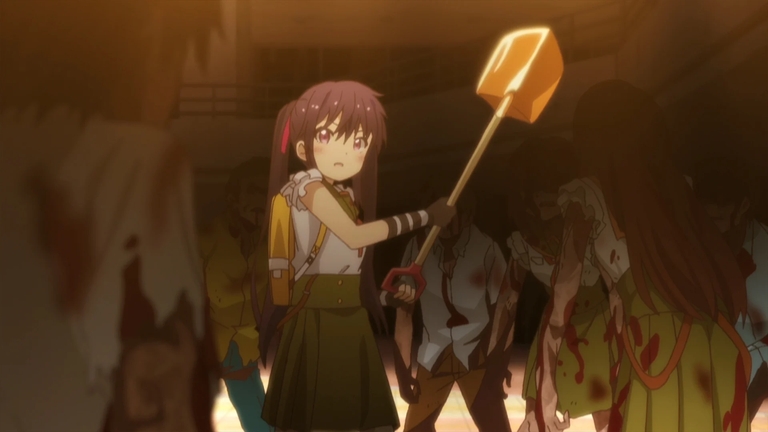
Kurumi has to kill her crush. He got infected, she had to put him down, and she never got to say goodbye. This isn't backstory flavor text. It's active trauma that makes her freeze up when she sees zombies wearing school uniforms. She stops seeing faces and starts seeing threats, which keeps her alive but burns away her empathy. The shovel becomes a barrier between her and the people she used to be. When she gets infected later in the series, it's almost a relief because she can finally stop fighting.
The horror here is intimate. These aren't anonymous monsters. They're the audience of the slice-of-life show that existed before the apocalypse. The girls are killing the extras from their own opening credits.
Moe as a Weapon
People dismiss this show as "cute girls doing cute things with zombies" and miss that the contrast is the entire thesis. The anime industry produces endless content about the idyllic school life, the club activities, the eternal spring of youth. School-Live! takes that aesthetic and infects it. The camera angles stay low and bouncy. The character designs stay round and soft. The music stays upbeat even when they're rationing food. It's wrong. It's deeply uncomfortable in a way that jump scares can't replicate because it feels like the show itself is mentally ill.
why the cute facade hides horror
This visual language forces the viewer into the same coping mechanism as the characters. You want to believe the brightness. You want to ignore the blood spatter texture on the wall because the girls are having a picnic. The show trains you to dissociate along with Yuki, which makes the moments when reality crashes through feel like personal violations. Episode 10 hits different because by that point you've bought into the delusion. You wanted the school to be safe. You wanted the club to last forever. The show punishes you for wanting that.
The Sanctuary Falls
The middle episodes lull you into a false rhythm. They find a dog, Taroumaru, who represents pure innocence in the group. They establish routines. They clean rooms, cook meals, have sleepovers. It feels like they're building a life. Then the zombies breach the school. The power goes out. The barricades fail. The illusion that they can live inside a memory gets shredded.
This is where the psychological horror peaks. The school was never a home. It was a coffin they were decorating. Yuki's breakdown in the final episodes isn't sudden. It's the gradual realization that she can't hide anymore. When she finally sees a zombie Megu-nee and doesn't flinch, when she accepts that her teacher is dead and the school is over, she's not losing her mind. She's finally gaining it back. The graduation ceremony at the end isn't just leaving the building. It's graduating from denial into grief.
Why the Live Action Failed
The 2019 movie adaptation tried to copy the story but missed the point entirely. You can't translate moe to real actors without hitting the uncanny valley. The exaggerated cheerfulness looks fake and annoying instead of tragically fragile. The movie also front-loads the reveal, showing the zombies early, which destroys the psychological dissonance that makes the anime work.
Real actors can't capture the specific visual language of anime escapism. The bright colors look like bad lighting in live action. The physical comedy looks forced. More importantly, the movie couldn't replicate the unreliable narrator technique because film language defaults to objective reality. You can't have a character interact with a hallucination for half the runtime without the audience noticing something is wrong unless you control the color palette and physics like animation allows.
The Virus of Routine
The Omega virus or whatever they're calling the infection in the lore isn't the real threat. The real threat is routine. The girls maintain schedules, attend classes that don't exist, and follow school rules in a building with no authority. This ritual behavior keeps them human but also keeps them trapped. Miki is the only one who initially resists Yuki's delusion, having survived alone in a mall, and she represents harsh reality crashing into the group fantasy.

But even Miki gets absorbed into the delusion because reality is unbearable without filters. The show argues that sanity is collective. One person going crazy is a tragedy. Four people going crazy together is a coping strategy. They validate each other's lies until the lies become the only solid ground left.
Rewatching as Autopsy
Once you know the twist, the show becomes a different beast. You notice how Yuuri's hands shake when Yuki mentions Megu-nee. You see how Kurumi always positions herself between Yuki and the windows. The background art shifts from bright watercolors to gray photographic textures whenever Yuki isn't looking. The show was telling you the truth the whole time, but it was hiding it in plain sight like a magic eye puzzle.
psychological deception analysis
Every cheerful interaction is now loaded with subtext. Every time Yuki thanks Megu-nee for advice, the other girls are silently mourning. The show becomes about the weight of performance, how exhausting it is to pretend for someone else's benefit, and how necessary that performance is to prevent total collapse.
Survival Is Not Living
The final episodes destroy the school. They have to leave. Yuki gives a speech to an empty auditorium, addressing zombies as if they're underclassmen, and finally acknowledges that school is over. This is the most disturbing moment in the series because it's not a victory. It's surrender. She's accepting that the world is dead and she has to walk through it anyway.
School-Live! anime psychological horror analysis comes down to this. The zombies aren't the enemy. Grief is. The show is a twelve-episode study of how trauma fragments the self, how the mind protects itself with fantasy, and how cruel it is to wake up from a beautiful dream into a nightmare. It uses the language of comfort to discuss absolute despair, which makes the despair stick to your ribs longer than any gore could. The girls survive, but they leave their innocence buried in the rubble of the school, and that's the real tragedy.