
Any proper jojo's bizarre adventure: stardust crusaders anime analysis has to admit something right up front. This show is a beautiful disaster. It's forty-eight episodes long, it repeats the same villain formula for twenty straight episodes in the middle, and the main character has the emotional range of a concrete wall. But here's the thing. None of that matters because Hirohiko Araki invented the modern battle shonen here, and everyone else has been playing catch-up since David Production animated this beast in 2014.
You have to understand what came before. Parts one and two were about Hamon, which was basically magic karate breathing that let you punch vampires hard. Joseph Joestar doing his trickster nonsense in Battle Tendency is still some of the best anime ever made. But Stardust Crusaders threw all that out and said, what if we gave everyone invisible ghosts with weird specific rules instead. That's Stands. And Stands changed everything about how fights work in anime.
The setup is simple. Jotaro Kujo is a Japanese delinquent who thinks he's possessed by an evil spirit. Turns out it's Star Platinum, a Stand, and he's got one because Dio Brando is back from the bottom of the ocean. Dio attached his head to Jonathan Joestar's body, and that body swap awakened Stands in the entire Joestar bloodline. Including Holly, Jotaro's mom. Her Stand is killing her because she's too gentle to handle it. So Jotaro, his grandfather Joseph, and a bunch of other Stand users have fifty days to get from Japan to Egypt and kill Dio before Holly dies. Perfect for a road trip from hell.
The Shift To Stands Killed Power Levels
Let's talk about the fights. Before this, shonen battles were about power levels. Who punches harder, who trains more, who has the bigger spirit bomb. Araki looked at that and got bored. He wanted chess matches where one wrong move kills you. So Stands aren't just big fists, they're manifestations of your soul with specific weird limits that force you to think. Star Platinum has incredible speed and precision but only two meters of reach. Magician's Red controls fire but Avdol still has to aim it and worry about wind. Hierophant Green can possess people and shoot emeralds but it's fragile and can't take a hit.
This creates fights where brains matter more than biceps. The best example is D'Arby the Gambler. No punching at all. Just a poker game where D'Arby's Stand can steal your soul if you lose, and also read your soul to see if you're lying. Jotaro has to bluff without bluffing. He has to psych out a guy who can literally see through him. It's tense. It's weird. It's nothing like Dragon Ball Z. And that's the gift Stardust Crusaders gave to anime. Every battle shonen since, from Hunter x Hunter to Chainsaw Man, owes this structure a debt.
The problem is Araki was still figuring it out. Early Stands are basically just elemental powers with Tarot card names slapped on. Magician's Red is fire. Hierophant Green is... green stuff that wraps around things. Silver Chariot is a knight with a sword. It's only later in the season, and definitely in future parts, where Stands get truly bizarre with mechanical traps and automatic abilities. But even these simple powers force the characters to think tactically. Joseph can't just out-breath his enemies anymore. He has to use Hermit Purple, which is basically just psychic vines that take photos and let him swing around like Tarzan. He has to be smart again, which is good, because old Joseph is way more interesting than just another guy who punches fast.
The Cast Is Weird And Lopsided But It Works
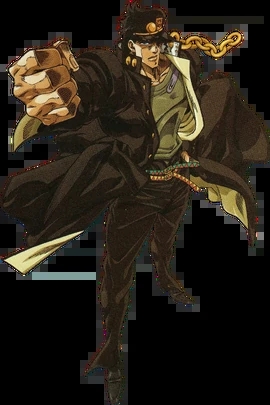
Jotaro Kujo is the protagonist and he's barely a character. He's stoic. He says "yare yare daze" which means good grief. He punches things and he cares about his mom. That's it. And that's the point. He's a reaction to the hyper-emotional shonen heroes who cry every episode. He's Clint Eastwood in a school uniform. The show doesn't need him to develop because the rest of the cast is crying and growing enough for everyone.
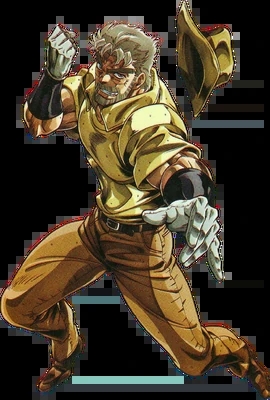
Joseph Joestar comes back from Part 2, now in his sixties, and he's the heart of the show. He's still loud, still panicking, still predicting what people will say next. But he's slower now. His Stand sucks for direct fighting. Hermit Purple is information gathering and grappling, not combat. So he plays support, and that makes him feel real. He gets scared. He gets hurt. When he dies temporarily against Dio, it hits hard because this guy carried the last season and now he's an old man trying to save his daughter with vines that break easily.
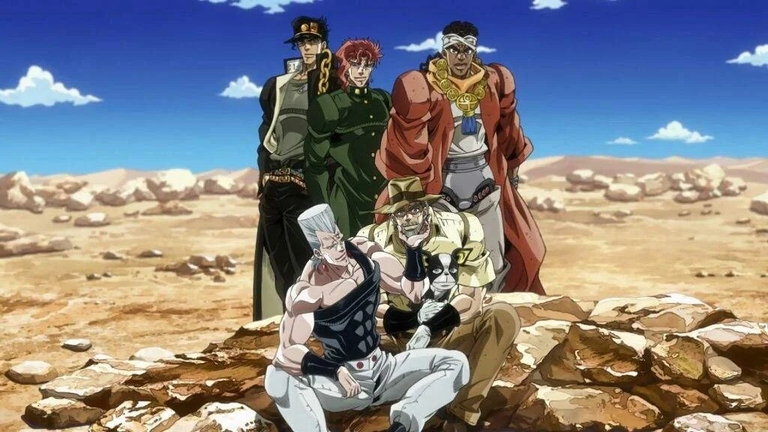
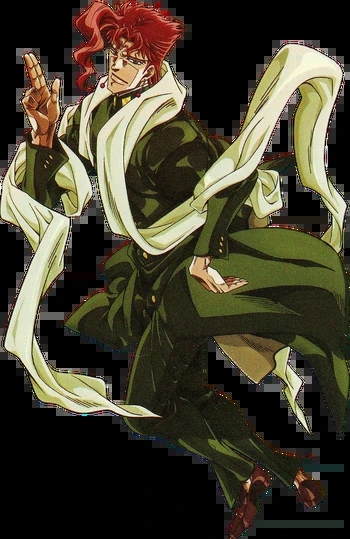
Then you've got Kakyoin, the gamer who was mind-controlled by Dio and now wants revenge. He's quiet, analytical, the only one who really thinks like Jotaro. Polnareff is the opposite, loud and French and obsessed with toilet humor, but he's got a real tragedy with his sister's murder driving him forward. Avdol is supposed to be the wise mentor but the show keeps sidelining him or fake-killing him, which is annoying because Magician's Red looks cool and Avdol has history with Dio that never gets explored enough. He deserved better than getting disintegrated by Vanilla Ice later on.
And Iggy. The dog. Joins halfway through in Egypt. People hate on Iggy because he's a jerk dog who farts on Polnareff and steals food, but he's got the best Stand, The Fool, which is a shapeshifting sand construct that can become anything. His fight against Pet Shop, the falcon with ice powers, is one of the best animated sequences in the whole show. No dialogue, just a Boston Terrier and a bird trying to murder each other in the Cairo sewers. Brutal stuff that proves Araki could tell stories without words.
The Road Trip Structure Is A Double Edged Sword
The forty-eight episode run is split into two cours. The first half is the journey to Egypt, the second is Battle in Egypt. And yeah, it drags. There's no getting around it. The show adopts a villain-of-the-week format where Dio sends assassins after the Crusaders, and they fight them on boats, planes, cars, and camels. Some of these fights are filler from the manga, and it shows. The Darby younger brother fight is just video games instead of cards, and it feels like padding where the show is buying time.
But the format works because it lets the characters breathe in between life or death situations. You get to see them stuck in a submarine trying not to get decompressed. You get to see Polnareff get attacked in a bathroom by a Stand that hides in mirrors. It's slice of life mixed with psychic murder. And it builds tension slowly. Every time they defeat an enemy, you know Dio is still sitting in his mansion, getting stronger, drinking wine, waiting. The clock is ticking on Holly, even if the show sometimes forgets to remind you she's dying until the plot needs urgency again.
The pacing is the biggest flaw in any jojo's bizarre adventure: stardust crusaders anime analysis you read online. People say you can skip episodes. Don't skip episodes. Just know that some of them are weird detours. The Death 13 episode with the baby in the dream world is creepy and great, showing how Stands can work on completely different rules. The episode with the ape on the ship is stupid and you can tell Araki was just trying to meet a deadline. That's the messiness. It's uneven. But the highs are so high that the lows don't matter. Even the bad episodes have creative visuals that other anime would kill for.
Dio And The Final Battle Hit Different
Let's talk about the villain. Dio Brando is back, and he's been upgraded from sneaky snake to confident king. He has The World, a Stand that stops time for five seconds. And he knows it. The final ten episodes are pure dread. Once the Crusaders reach Cairo, the show stops messing around with filler. Vanilla Ice, Dio's follower with a void Stand named Cream that eats space itself, kills Avdol and Iggy. For real. Permanently. This isn't Naruto where everyone comes back to life. Avdol gets disintegrated saving Polnareff. Iggy dies protecting Polnareff from Vanilla Ice, bleeding out in the sand after using his last strength.
Those permanent deaths raise the stakes and make the final confrontation matter. When Jotaro finally faces Dio, it's not just about Holly anymore. It's about Avdol and Iggy and Kakyoin, who dies figuring out The World's time stop secret. Kakyoin's final moment, shooting the clock tower with Emerald Splash to tell Joseph the secret of the time stop, is the emotional peak of the whole season. He dies alone in the street knowing he won.
And the fight itself. Time stop versus super speed punching. Dio dropping a road roller on Jotaro and screaming "WRYYYY." Jotaro learning he can stop time too, not because he trained, but because he's a Joestar and Star Platinum is the same type of Stand as The World. It's nonsense. Beautiful nonsense that only works because the show committed to its rules for forty episodes prior. The OVA from the nineties apparently did the animation better for this specific fight, with smoother shading and weightier impacts according to some animation comparisons, but the David Production version has better voice acting and music that makes the scene hit harder emotionally.
Why It Still Matters Despite The Mess
Stardust Crusaders isn't perfect. It's too long. Jotaro never develops a personality beyond "cool guy who cares about his mom." Some Stands are just "guy with sword" or "guy with fire" with no creativity. But it established the template for everything that followed. The road trip structure. The weird powers based on psychological traits. The fashion that looks like high-end designer clothing mixed with school uniforms. The references to classic rock bands that got changed in the subtitles to avoid lawsuits, so you get "Cool Ice" instead of Vanilla Ice and "Dan of Steel" instead of Steely Dan.
It proved that you can have a shonen where the hero wins by out-thinking the villain, not just screaming louder and getting a new form. Every part after this builds on that foundation. Diamond is Unbreakable, Golden Wind, Stone Ocean, none of them exist without Part 3 taking the risk of dumping Hamon for Stands and committing to the weirdness. Some fans argue that later parts improved on the formula with better pacing, but Part 3 is the progenitor that made it possible.
If you're going to watch it, don't binge it in one sitting. Watch two episodes, take a break. Let the weirdness settle. Appreciate that this was made by a guy who was clearly making it up as he went along, drawing whatever looked cool, but had enough raw talent that even his filler episodes about a gambler or a baby in dreams are more creative than most anime climaxes. The full series review points out how the sense of dread builds effectively even during the slower middle episodes.
A Japanese fan's impressions noted that Joseph remained the highlight despite his age, and that the final moments where Hamon prolonged Joseph's life connected back to the legacy of Parts one and two beautifully. That continuity matters. This isn't just a new story, it's the culmination of the Joestar bloodline fighting the same vampire across three generations.
Jotaro became a marine biologist later in the story, which is perfect for his quiet weirdness and love of the ocean. Joseph survived, somehow, because he's too stubborn to die even when his blood is replaced by Dio's. Polnareff got his revenge but lost everything anyway, ending up alone in a wheelchair. That's Stardust Crusaders. You win, but you lose friends doing it. And you look incredible while it happens, wearing designer clothes and punching ghosts.
Watch it. Skip the ape episode if you want, I won't tell anyone. But don't skip the rest. You need to see where modern shonen came from, and why every time you see a "punch ghost" in a new anime, it's bowing to JoJo. It's messy, it's too long, and it's absolutely essential. This jojo's bizarre adventure: stardust crusaders anime analysis ends here. Yare yare daze.