
Most Given anime series review threads start with a lie. They call it a "boys love" show and then spend ten paragraphs ranking the kissing scenes. That's not what this is. This is a show about a dead kid named Yuki and the red guitar he left behind, and how his boyfriend Mafuyu carries that guitar like it's a severed limb. Everything else, the band, the romance, the high school drama, that's just the noise around the central wound.
Studio Lerche adapted Natsuki Kizu's manga back in 2019 for the Noitamina block, which was apparently a big deal for being the first BL in that slot. Whatever. What matters is they didn't sanitize the grief. Mafuyu Sato shows up in episode one holding a Gibson ES-330 with broken strings, and he doesn't talk much. He just holds that thing. Ritsuka Uenoyama finds him napping on a stairwell with the guitar clutched to his chest like a life preserver, and that's the whole show right there. You've got a kid who can't play the instrument that killed his boyfriend, and another kid who fixes the strings without asking why they're broken.
Why This Isn't Your Typical BL Checklist
I've read the MyAnimeList reviews. I've seen people describe this as "the one where the uke is apathetic and the seme is ashamed" like that's insightful. That's missing the point so hard it should hurt. Given doesn't play the seme-uke game. There's no height difference power dynamic. No "you're mine" possessive garbage played as romantic. No accidental touching that turns into assault played for laughs. People on MAL keep trying to fit these kids into boxes that don't exist.
Ritsuka and Mafuyu talk like actual gay teenagers, not like BL stereotypes having a script meeting. Ritsuka spends half the series confused about why he cares so much, cycling through denial and embarrassment like a normal human. Mafuyu spends half the series unable to speak because his last relationship ended with a corpse. That's not a dynamic. That's just trauma and confusion meeting in a practice room.
The show respects the fragility of the whole thing. When they finally get together, it's not because of fate or destiny. It's because Ritsuka realizes he can't stand watching Mafuyu suffer alone anymore. That's it. That's the whole romance. No fireworks, no dramatic declarations in the rain. Just two kids who play guitar and one of them finally asks if he can kiss the other.
The Guitar Is a Corpse
Let's talk about that Gibson. Mafuyu carries it everywhere but he doesn't play it. He just holds it on trains, in class, while he's sleeping. It's red, which is important, because it looks like a fresh wound against his pale sweaters. Ritsuka fixes the strings in the first episode and the show frames it like a meet-cute, but it plays more like an autopsy. Those strings didn't break by accident. Either Yuki broke them before he died, or Mafuyu broke them after, or they just snapped under the weight of being ignored for months.
Yuki Yoshida is dead when the show starts. Suicide. The show doesn't treat him like a plot device to move the romance forward. Through flashbacks that are brief but sharp, you see him alive. You see him laughing with Mafuyu on a bike. You see them fighting in the rain, Mafuyu saying things he can't take back, Yuki looking broken. You see the aftermath, the empty room, the guitar sitting there like evidence.
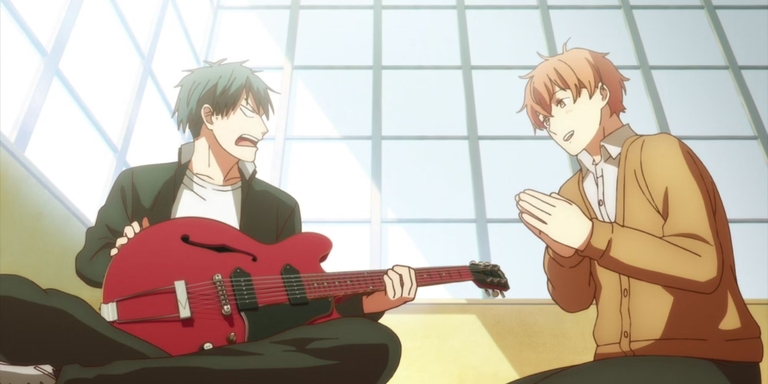
The guitar has broken strings because it's frozen in time. It's stuck on the last moment Yuki touched it. Mafuyu can't restring it himself because that would be moving on. He makes Ritsuka do it because Ritsuka doesn't know the history. He's just a guy who sees broken things and wants to fix them. That's their whole relationship in one action. Ritsuka fixes what Mafuyu is too scared to touch.
Episode Nine Will End You
If you're reading this Given anime series review to see if the show is worth your time, just know that episode nine exists. The first eight episodes are buildup, practice sessions, quiet conversations in dimly lit rooms. Then episode nine happens and it feels like getting punched in the sternum.
The band, which gets named Given halfway through because they're all named after seasons, plays their first real show. Mafuyu has been sitting on a melody that Ritsuka wrote, but he can't write lyrics. He tries. He writes "winter story" and nothing else. He can't say he blames himself for Yuki's death. He can't say he's angry at Yuki for leaving. He can't say he wants to live but doesn't know how. So he writes nothing.
Then he gets on stage. The lights are too hot. Ritsuka is playing guitar and looking at him like he's scared Mafuyu might disappear. Akihiko is on drums, Haruki on bass. They start playing. Mafuyu opens his mouth, and instead of the lyrics they practiced, he sings "Fuyu no Hanashi." A Winter's Story.
Shougo Yano, the voice actor, doesn't sound like an anime character here. He sounds like a kid who has been holding his breath for months and is finally exhaling blood. The lyrics are simple. "I couldn't say anything, I couldn't say anything, I couldn't say anything." He just repeats it, getting louder, the band behind him realizing they're not playing a song anymore, they're playing an exorcism. The lyrics aren't poetic in a fancy way. They're repetitive because when you're grieving, you don't have deep thoughts. You have the same thought over and over. "I should have said something. I should have noticed." The song ends with Mafuyu screaming, not words, just sound. It's a release in a way that makes you feel like you've been holding your breath for twenty-two minutes.
The crowd doesn't know what to do. Some cry. Some just stand there. Ritsuka is crying while he plays, which is impossible because you can't see through tears and play power chords, but he does it anyway.
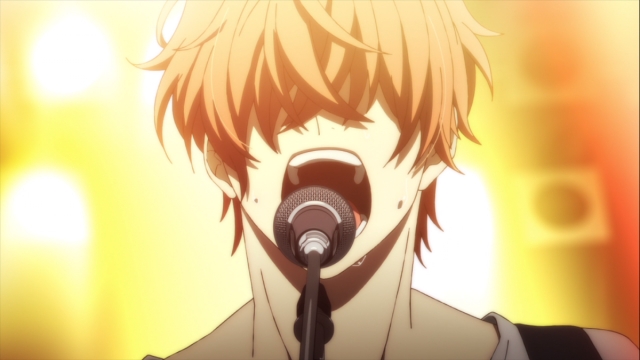
The animation switches to CG during the guitar solos and yeah, it looks like a video game cutscene from 2006. The models are stiff. But you don't care. BlerdyOtome put it right, the manga can't sing to you, but this can. Centimillimental, who did all the original music, understood that this moment needed to hurt in a way that subtitles can't translate. It does.
The Side Couple Is Messy
While Ritsuka and Mafuyu are doing their slow-burn healing, the adults are falling apart in the background. Akihiko Kaji plays drums like he has four arms but lives like he has zero self-worth. He's in a relationship with Ugetsu Murata, a violinist who might be the most toxic love interest I've seen in anime that isn't played for horror.
Their apartment is a war zone. Ugetsu destroys Akihiko's confidence on purpose, telling him he's mediocre, telling him he's pathetic, then crawling into his lap like nothing happened. Akihiko takes it because he thinks he deserves it. He thinks being treated like garbage is the price of being loved. It's hard to watch because it's real. I've known people in relationships like this. You want to scream at the screen for Akihiko to leave, but you know he won't, not until he's completely broken.
Ugetsu plays violin, and the show uses this to show how different his relationship with Akihiko is compared to the band's music. Ugetsu's music is classical, controlled, perfect, and empty. Akihiko's drumming in Given is chaotic, emotional, messy, and alive. That's the choice he has to make. Perfection with Ugetsu that kills him, or mess with Haruki that might really let him breathe.
Meanwhile, Haruki Nakayama, the bassist with the ponytail, is quietly dying inside because he's been in love with Akihiko for years. He watches this train wreck from the front row, waiting for scraps. He's not a saint either. He's complicit in his own misery. He knows Akihiko is taken. He knows it's destroying him to watch. He does nothing.
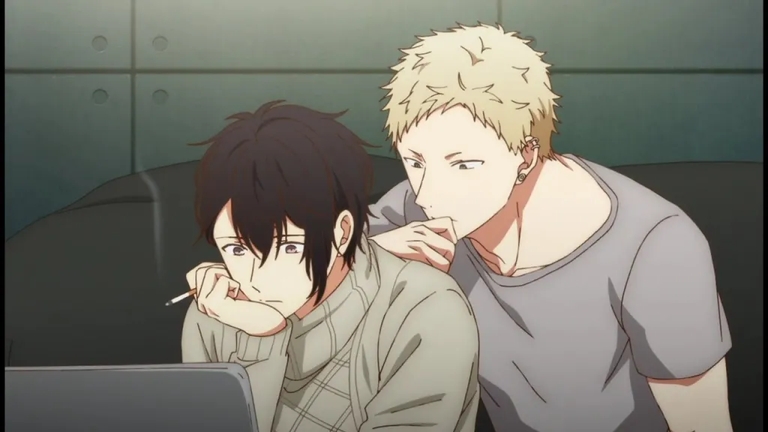
The anime only gives this subplot a few episodes because it has to focus on the kids, but you get enough to know it's complicated. When Akihiko finally leaves Ugetsu, it isn't because he had a realization about loving Haruki. It's because he couldn't breathe anymore. That's how breakups work in real life. You don't switch partners like changing clothes. You escape first, then figure out if you're capable of loving someone else later.
The Animation Is Honest About Its Flaws
Studio Lerche made some weird choices. They used CG for the instruments during performance scenes. Not all the time, but enough that you'll notice the guitars look plastic. The fingerings are accurate, which some bass player on Reddit pointed out is technically correct, but the models look like they're from a PS2 game sometimes. It's distracting.
But then they'll animate a conversation in a stairwell with such perfect lighting that you forget about the bad CG. The show loves shadows. Ritsuka and Mafuyu talk in dimly lit hallways, under yellow streetlights, in practice rooms with the blinds half-closed. It looks like real life. It looks like winter afternoons when the sun sets at four pm and everything feels heavy.
The character designs are simple on purpose. Mafuyu has that blank stare that could mean he's sad or just tired or maybe he's not even there mentally. Ritsuka looks like every delinquent lead from every other show, but he fidgets more. He plays with his hands when he's nervous. He looks away when he lies. It's small, but it sells the whole thing. These kids move like teenagers. They slouch. They don't make eye contact when they should.
The Soundtrack Is A Character
Centimillimental, which is apparently just one guy named Atsushi, composed everything. The opening, "Kizuato" or Scar, sounds like a band actually playing in a garage. It's messy. The vocals are mixed too loud. The drums sound like they're recorded in a small room. That's perfect. It doesn't sound like a polished pop single. It sounds like four guys who are figuring it out.
The ending theme, "Marutsuke" or The Right Answer, is softer. It plays over scenes of the characters walking home in the dark, carrying their instruments. It feels like winter. It feels like the end of a long day when you're too tired to think.
Then there's "Session," the instrumental jam they play in the practice room. It doesn't have lyrics. It's just guitars and drums building up and falling down. It sounds like anxiety. It sounds like wanting to say something and losing your nerve at the last second.
Why The Anime Beats The Manga Here
I need to talk about the source material because people always ask. Natsuki Kizu's manga is gorgeous. The art is sketchy and emotional, all rough lines and watery eyes. But it has one huge problem that the medium can't fix. It's silent. You can't hear the music.
When you read the manga, you see the lyrics on the page. "Fuyu no Hanashi." You imagine what it sounds like. Maybe you YouTube a cover. But when you watch the anime, you hear the actual song. You hear Shougo Yano breaking his voice on the high notes. You hear the guitar feedback. You hear the drum fill that Akihiko throws in when he gets emotional.
The anime fixes what the manga lacks. It gives the grief a soundtrack. That's why this adaptation is essential. You can read the manga for the full story, especially the parts the anime skips, but you cannot understand the impact of Mafuyu's healing without hearing him sing. It's the difference between reading a poem and hearing someone cry while they recite it.
The Pacing Is Slow Because Grief Is Slow
Some people complain that nothing happens for the first six episodes. They say it's boring. Ritsuka teaches Mafuyu the D chord. They go to the beach and don't swim. They eat convenience store food and talk about nothing. The band practices the same song until your ears bleed.
They're not wrong. It is slow. But grief is boring. Healing is slow. You don't get over your dead boyfriend in a three-minute montage set to pop music with sparkles in the background. You get up. You carry the guitar even though it hurts your back. You learn one chord. You forget it. You learn it again. You have a good day and then you see a red sweater in a store window and you can't breathe. The show respects that timeline. It doesn't rush Mafuyu. It lets him be quiet. It lets him take up space without explaining himself.
When The Romance Actually Happens
By the time Ritsuka kisses Mafuyu backstage after the concert, it doesn't feel like a fan service reward. It feels like a relief. These kids have been circling each other for weeks, not because of will-they-won't-they tension, but because Mafuyu is grieving and Ritsuka is terrified of being a replacement for Yuki.
The show treats consent like it's normal, which is sad that I have to point this out as a positive in this genre. Ritsuka asks if it's okay. Mafuyu says yes. They kiss. It's awkward. Their teeth click. Ritsuka runs away afterward because he's overwhelmed. It's real. It's not sparkly. It's two teenagers who don't know what they're doing but know they want to do it anyway.
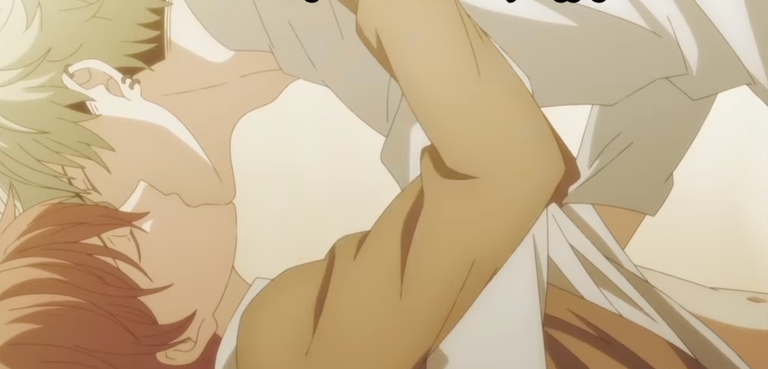
Later, when Ritsuka tells him "you did so damn well," he's not talking about the singing. He's talking about surviving. That's the moment you realize this kid gets it. He understands that Mafuyu didn't just perform a song, he climbed out of a grave. That's what the romance is. It's not about possessing Mafuyu. It's about witnessing him and saying "I'm here, I'm not going anywhere."
The Names Mean Something
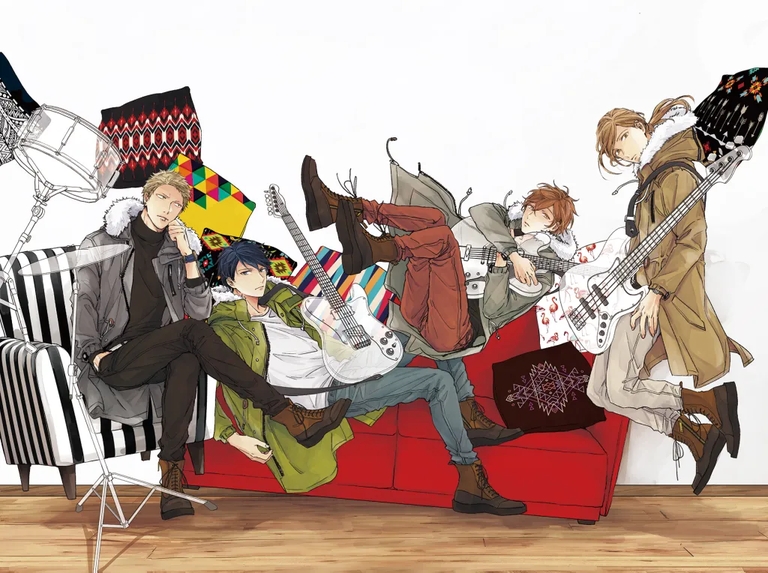
Ritsuka is "summer." Mafuyu is "winter." Akihiko is "autumn." Haruki is "spring." That's the band. Given. The seasons. It sounds pretentious but it works. They're stuck in different times. Mafuyu is frozen in winter, in death. Ritsuka is burning out in summer, too hot to touch. Haruki is waiting for spring, for new growth. Akihiko is falling, always falling, through autumn.
Every episode title is a British alternative rock song from Ritsuka's playlist. You don't need to know that to enjoy the show, but it tells you what he's listening to when he runs. It tells you what kind of music made him want to play guitar in the first place. It's details like that which prove the creators weren't just checking a BL quota. They were building a world.
The Problems Nobody Wants To Admit
It's not perfect. The side characters get shafted hard. Yayoi, Ritsuka's sister, is just there to ship them and make weird comments. The other bands they meet are cardboard cutouts. The rival band members have no personality beyond "we're also in a band."
And yeah, the CG is bad. I said it before but it bears repeating. During the climactic song, when the camera pans to the guitars, it looks like someone switched the channel to a cutscene from Guitar Hero circa 2005. It's jarring and it takes you out of the moment.
Some people think the suicide backstory is handled too gently, like the show is afraid to really look at the ugliness of it. They argue that we only see Yuki in soft focus, in happy memories, and that sanitizes the violence of what he did. I don't know if I agree, but I get it. The show is careful. Maybe too careful. Maybe we needed to see the mess Yuki left, not just the guitar.
The Final Verdict
Given isn't just another BL entry. It's a music show about trauma that happens to have gay characters. It's eleven episodes on Crunchyroll, plus a movie sequel that focuses more on Akihiko and Haruki's relationship. The movie, which came out later, is more explicit, more adult, more painful. But you need to watch the series first. The series is the heart. The movie is the aftermath.
Should you watch it? If you want a music anime where the band really practices and argues about chord progressions, yes. If you want a romance where the characters act like humans instead of archetypes, yes. If you need something that respects the weight of death and doesn't offer easy answers, absolutely.
Given anime series review scores are usually high, like 8 out of 10 stuff. I'd say it's a solid 8 that becomes a 10 during episode nine. You can skip around the slice-of-life parts if you're impatient, but you'll miss the buildup that makes the concert hit so hard. It's not a show you binge for fun. It's a show you watch when you need to cry about something you lost, and then feel a little better after.
Bring tissues. Not for the kissing. For the grief.