
Most mystery anime treat viewers like idiots. They hold your hand through obvious clues then act shocked when the killer turns out to be the creepy guy acting creepy in episode one. That's not a mystery. That's a waste of bandwidth. Best mystery anime recommendations should challenge you to pay attention, plant clues you'll miss the first time but notice on rewatch, and deliver endings that don't pull solutions out of thin air.
You know the type I'm talking about. The ones where the detective suddenly remembers a childhood trauma in the final episode that just happens to explain everything. Or the "it was all a dream" twist that renders the previous twelve episodes pointless. Garbage. Absolute garbage. The titles worth your time play fair. They give you the same information as the characters and let you race against them to figure it out. They don't cheat with hidden information or break their own rules for shock value.
This list isn't ranked because comparing Monster to Odd Taxi is like comparing a novel to a short story. They're different beasts. But they're all honest with their audiences. They don't waste your time with filler arcs or power-ups that solve everything. And they prove that animation can handle mystery just as well as any live-action prestige drama, sometimes better because the medium allows for visual tricks and psychological landscapes that film can't touch.
The Gold Standard
Let's get the obvious one out of the way. Monster is seventy-four episodes long and not a single one is filler. Dr. Kenzo Tenma saves a kid's life over a politician's, loses his career, and nine years later that kid turns out to be a serial killer named Johan. Tenma spends the entire series chasing him across Europe while questioning his own morality and the value of human life. Naoki Urasawa wrote this and he doesn't do hand-holding. Every character has depth. Every clue matters. The mystery isn't just "where is Johan" but "what broke him in the first place" and "can Tenma stop him without becoming him." It's slow. Methodical. You have to pay attention to newspaper headlines in the background and remember faces that show up for thirty seconds in episode twelve. If you want a show that treats you like an adult, this is it. The pacing might annoy people who want answers in the first three episodes but that's their loss. The slow burn makes the reveals hit harder.
Then there's Death Note. Yeah, everyone has seen it. But there's a reason it shows up on every list of best mystery anime recommendations. Light Yagami finds a notebook that kills people and decides to become God. L decides to stop him. What follows isn't action scenes but psychological warfare conducted through potato chips and fake rules. The mystery isn't who has the notebook. It's how they'll outwit each other this week. The second half falls apart when Near shows up because the writers clearly didn't plan for the series to continue that long, but those first twenty-five episodes are airtight. Every move has a counter-move. Every plan has a backup plan. It's chess with death gods. The cat-and-mouse game works because both sides are smart and the show respects that intelligence by letting them fail and adapt instead of just powering through with plot armor.
Modern Hidden Gems
Odd Taxi came out and nobody watched it because it looks like a kids' show about animals. Big mistake. It's a neo-noir about a walrus taxi driver who gets involved with a missing girl case that connects to the yakuza, corrupt cops, and a viral idol. The writing is sharper than anything else from that year. Every passenger in his taxi matters. Every conversation that seems like filler is loading the gun for the final episodes. When the reveal hits, it doesn't come from nowhere. You had all the pieces. You just didn't know how they fit together. That's the mark of a great mystery. The character designs might throw you off but stick with it. The ending pays off every single subplot.
The Apothecary Diaries is newer but it's already solid. Maomao gets sold into imperial service and uses her knowledge of poisons and medicine to solve mysteries in the emperor's harem. It's historical fiction with a forensic angle. She doesn't have magic powers. She just pays attention to what people ate, what plants grow where, and who benefits when a concubine gets sick. The politics are messy. The court is full of backstabbers. And Maomao just wants to solve puzzles and get paid. It's refreshing to have a protagonist who isn't trying to save the world, just figure out who poisoned the soup. The medical details are surprisingly accurate for a period piece and the mysteries follow logical deduction rather than convenient coincidence.
Summertime Render starts with a guy going home for a funeral and ends with time loops, shadow monsters, and existential horror. Shinpei returns to his island hometown after his adoptive sister drowns, except she has bruises on her neck that suggest murder. Then people start disappearing. Then he dies and wakes up three days earlier. The loop mechanic isn't just a gimmick. Every reset gives him new information but the shadows are learning too. It keeps the tension cranked to eleven because mistakes aren't just setbacks, they're permanent deaths. The mystery of what the shadows are and why they're on the island unfolds beautifully across twenty-five episodes. Unlike some shows that use time travel to fix everything at the end, this one has rules that stick and consequences that matter.
Psychological Warfare
Higurashi no Naku Koro ni looks like a cute slice-of-life about kids in a rural village until it isn't. Keiichi moves to Hinamizawa and befriends a group of girls. Then people start dying around the annual festival. Then he starts dying. Then the timeline resets and we see the same summer from a different angle. It's a time-loop mystery where the loops aren't just for the protagonist. We see events from Rena's perspective, from Mion's, from Rika's. Each arc gives you new pieces of the puzzle. The horror comes from watching these kids you care about break under pressure and do terrible things. When you finally learn what's causing the loops and why the village is cursed, it hits hard because you've watched them suffer through it six times already. The rewatch value is incredible because once you know the truth, every early episode plays differently.
Serial Experiments Lain is from the nineties and it's still weird. Lain is a middle schooler who gets an email from a dead classmate and starts dissolving into the Wired, which is basically the internet but also maybe the collective unconscious. Reality starts bending. She meets men in black. Her family acts wrong. The show doesn't explain much. You have to piece together what the Wired is, what Lain is becoming, and whether she's saving the world or destroying it. It's dense. You'll probably need to look up explanations after. But it's honest about being confusing. The mystery is the nature of existence itself, and it earns its ambiguity. The visual storytelling does heavy lifting with computer imagery and repeated motifs that hint at the truth without spelling it out.
Mononoke is visually stunning and criminally underwatched. The Medicine Seller travels feudal Japan killing spirits called mononoke, but he can't just stab them. He has to learn their Form, Truth, and Reason first. Each arc is a self-contained mystery where someone is being haunted, and through investigating their trauma and secrets, he uncovers what the spirit really wants. The art style looks like traditional Japanese paintings exploded into animation. The stories deal with abortion, war guilt, and greed. It's heavy stuff wrapped in gorgeous colors. The investigation format means every episode is a new puzzle with fair clues hidden in the visual background.
Sci-Fi Done Right
Psycho-Pass is set in a future where a computer system scans your brain to determine if you'll commit crimes. Inspectors hunt people whose Crime Coefficient gets too high. Akane joins the police and immediately realizes the system is broken. The first season deals with a killer who can commit murders without raising his coefficient, exposing the flaws in Sibyl's judgment. It's a mystery about free will versus determinism. The cases are episodic but build toward a larger conspiracy about what Sibyl actually is. It gets political without being preachy. Just don't watch season two. It exists but it's not by the same writer and it shows. The original series handles the philosophical questions with more care than the later installments.
ID: Invaded has a premise that sounds like Inception fanfiction but works better than it should. Detectives use a machine to enter the subconscious minds of killers, represented as surreal virtual worlds called id wells. Only killers can enter id wells, so they use a convicted murderer named Akihito to investigate other murderers. He has to solve the mystery of each id well to find clues about where the real-world killer is. The visuals get wild. One id well is a fragmented city where time flows backwards. Another is an infinite falling building. The overarching plot connects all the standalone cases into a larger pattern about a serial killer creating other serial killers. It's smart sci-fi that uses its concept for actual detective work instead of just action scenes.
Erased gets flak for its ending but the setup is brilliant. Satoru has a power called Revival that sends him back in time to prevent tragedies. When his mom gets murdered, he gets sent back eighteen years to his childhood to stop the serial abductions that started everything. The mystery of who the kidnapper is works because the suspect pool is small and everyone acts suspicious. You get attached to the kids Satoru is trying to save. The killer's identity makes sense on rewatch. The final confrontation is a bit Hollywood, but the trip there is solid emotional storytelling with real stakes. The time travel mechanics are consistent and the clues are visible if you're paying attention to the backgrounds.
Supernatural Suspense
The Promised Neverland's first season is a masterclass in tension. Emma, Norman, and Ray grow up in an orphanage where the kids get "adopted" and never heard from again. They discover they're actually livestock being raised for demons. The mystery is how to escape with thirty other kids when they're surrounded by a forest full of monsters and their "Mom" is a former escapee who knows all their tricks. It's a battle of wits. Every episode ends on a cliffhanger. The second season is a dumpster fire that skips entire arcs of the manga, so just watch season one and read the manga or pretend it ended there. The early episodes are worth it for the chess-match pacing alone.
Another is a ghost story mystery. Class 3-3 has a curse where students die gruesome deaths every year. Kouichi transfers in and meets Mei, a girl everyone ignores. The mystery is figuring out who's actually dead already, because the curse happens when there's an extra student who doesn't know they're dead. It's Agatha Christie with horror movie deaths. The red herrings are obvious but the atmosphere is thick. You can play along at home trying to guess which character is the ghost before the reveal. The rules are established early and the solution follows them exactly.
The Underdogs Worth Your Time
Hyouka isn't about murder. It's about a guy who wants to save energy being dragged into solving mysteries by a curious girl. The mysteries are small. Why did the teacher borrow a book? Where did the locked room club announcement come from? But the solutions are clever and character-driven. It's about the joy of curiosity itself. The animation is gorgeous Kyoto Animation work. If you want something lighter that still makes your brain work, this is the pick.
Great Pretender follows con artists running international scams. Makoto gets roped into a team led by Laurent, a Frenchman who never loses. Each arc is a different heist with a mystery about who is really conning who. The visuals pop with color. The music slaps. And the twists land because they establish the rules of each con early then break them in satisfying ways. It's Ocean's Eleven as an anime and it deserves more attention.
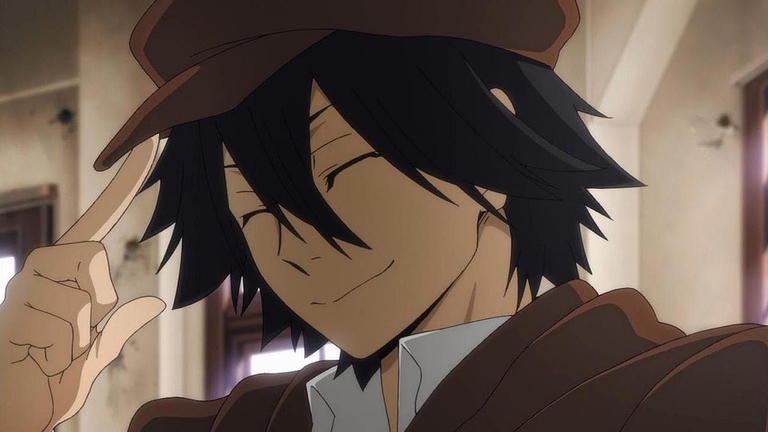
Bungo Stray Dogs starts rough. Season one is mostly setup and comedy. But season two and beyond turn it into a solid mystery-action hybrid about detectives with supernatural powers based on literary authors. The Port Mafia arcs get into some heavy noir territory. Dazai is the breakout character for a reason. He's funny but dangerous. The mystery elements come from figuring out how abilities work and who is pulling strings behind the terrorist attacks on Yokohama.
Ghost in the Shell: Stand Alone Complex needs mentioning even though it's older. Section 9 hunts the Laughing Man, a hacker who exposes corporate and government corruption. The mystery of his identity is secondary to the mystery of why he's doing it and what he's trying to expose about the system. It's cyberpunk that predicted social media manipulation and manufactured news cycles. The philosophical questions about identity and consciousness in a digital age still hit hard twenty years later.
The Bottom Line
You don't need to watch all twenty of these. Pick based on your mood. Want something heavy that will wreck you emotionally? Go Monster. Want something you can binge in a weekend? Odd Taxi or Erased. Want to feel smart without getting depressed? Hyouka. The best mystery anime recommendations aren't about checking boxes. They're about finding stories that stick with you because you earned the ending alongside the characters.
Stop settling for mystery shows that cheat. Stop accepting "it was magic" or "they were crazy" as explanations. Mystery is a contract between creator and audience. They promise to play fair. You promise to pay attention. These shows honor that contract. Everything else is just noise.
Pick one. Start tonight. And pay attention to the background details. They're never just background details.